Recurrences and generating functions
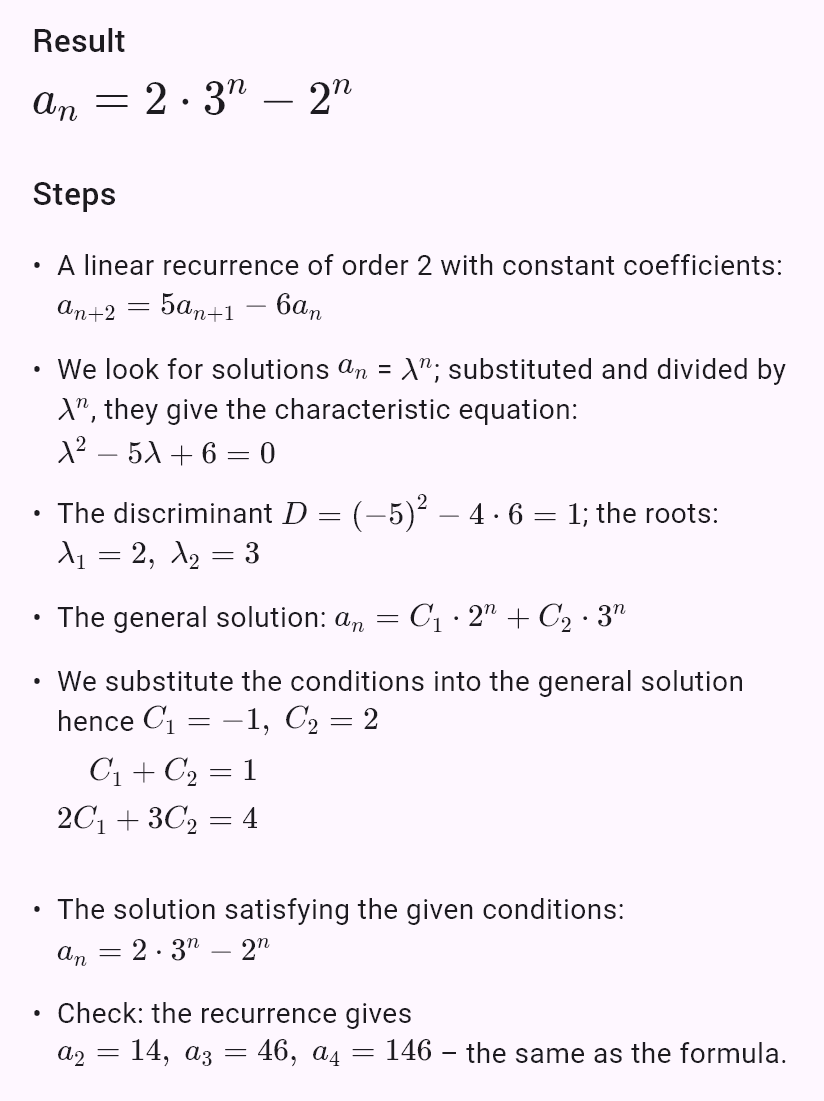
The app solves linear recurrences with constant coefficients of any order by the characteristic equation – multiple and complex roots too (the complex form of the solution and its conversion to the real one by de Moivre's theorem) – and with a right side of the form P(n)·qⁿ (also cos nφ, sin nφ, resonance and a sum of right sides). The initial conditions determine the constants; as a check, the app computes further terms from the recurrence and compares them with the formula.
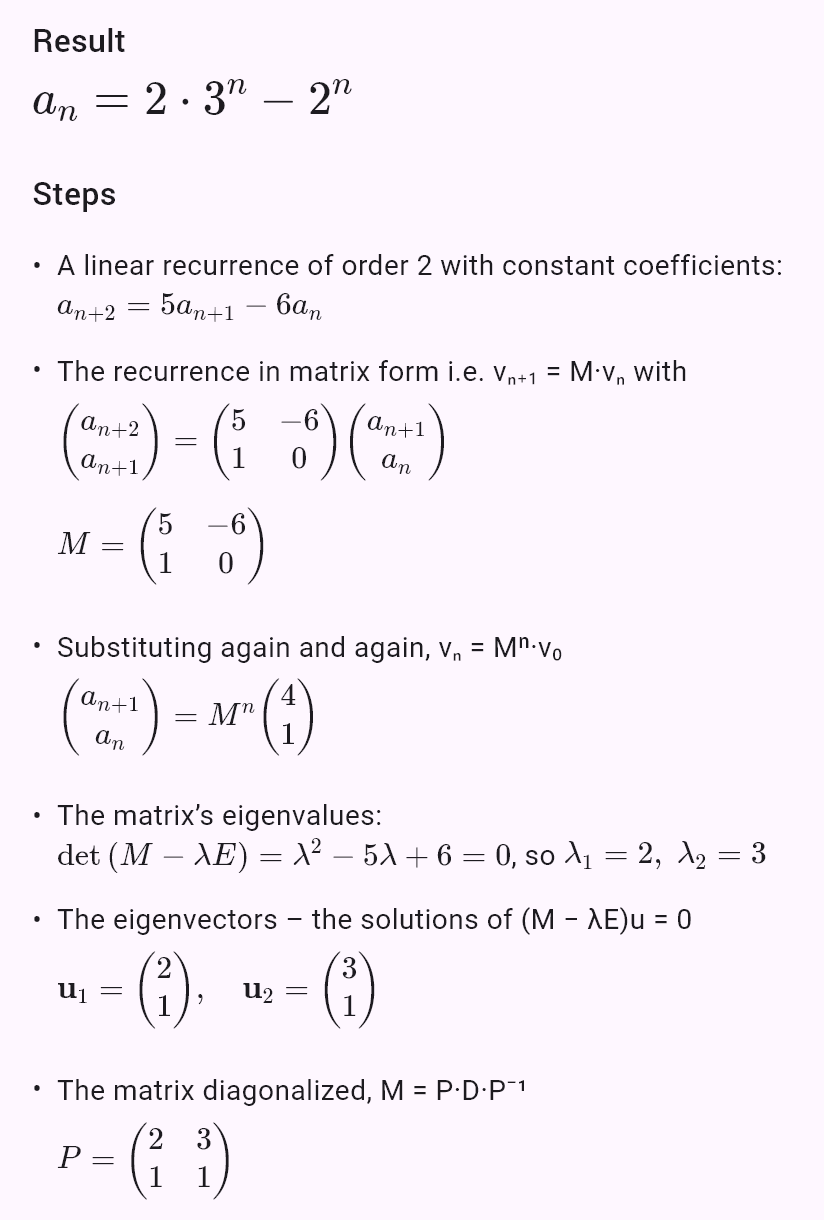
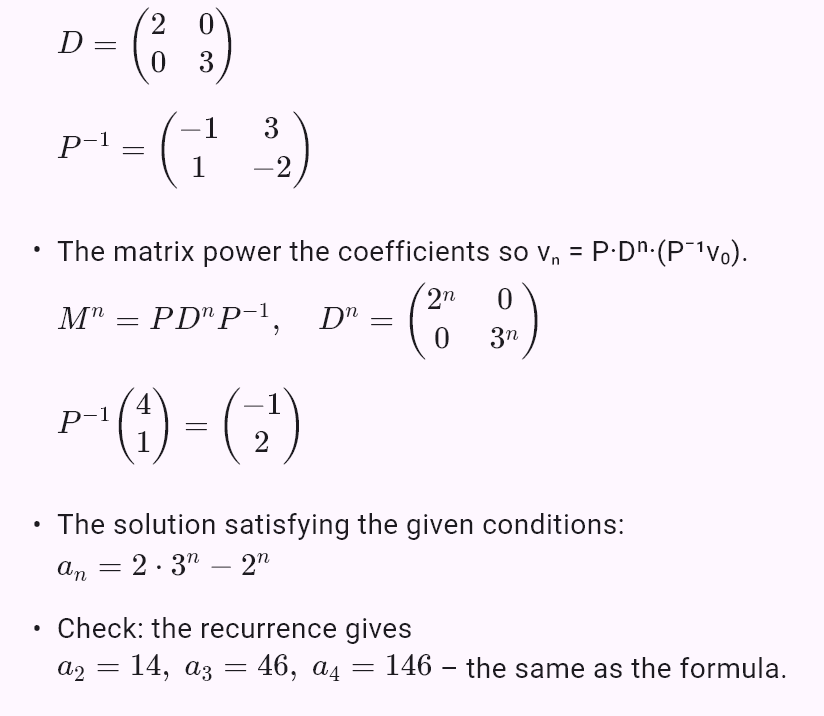
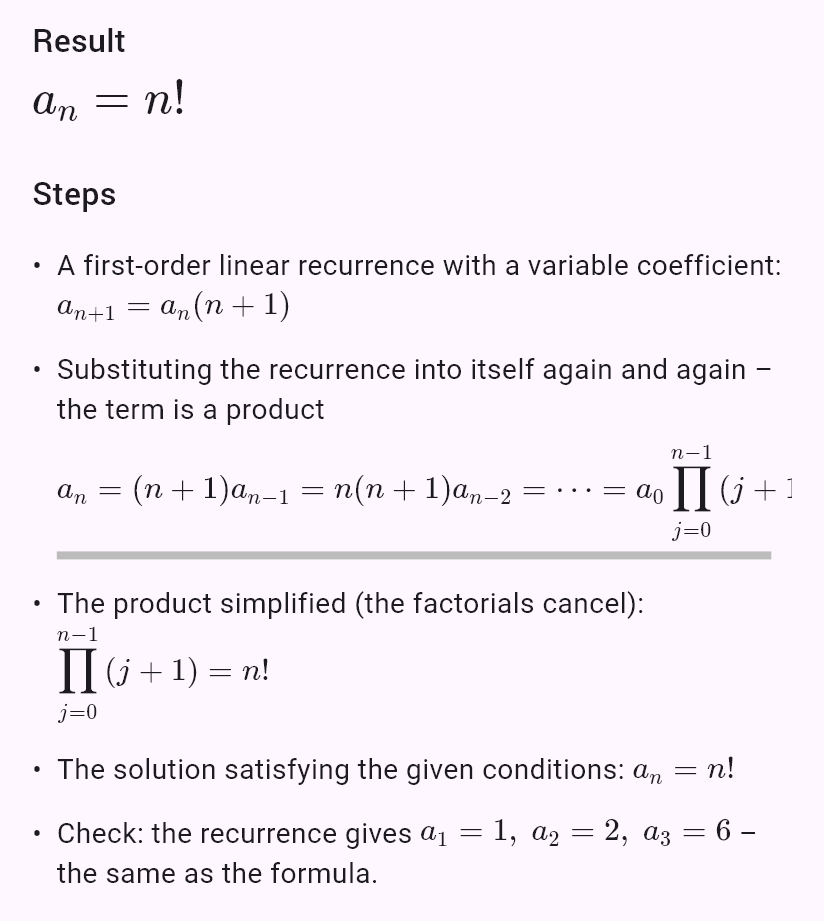
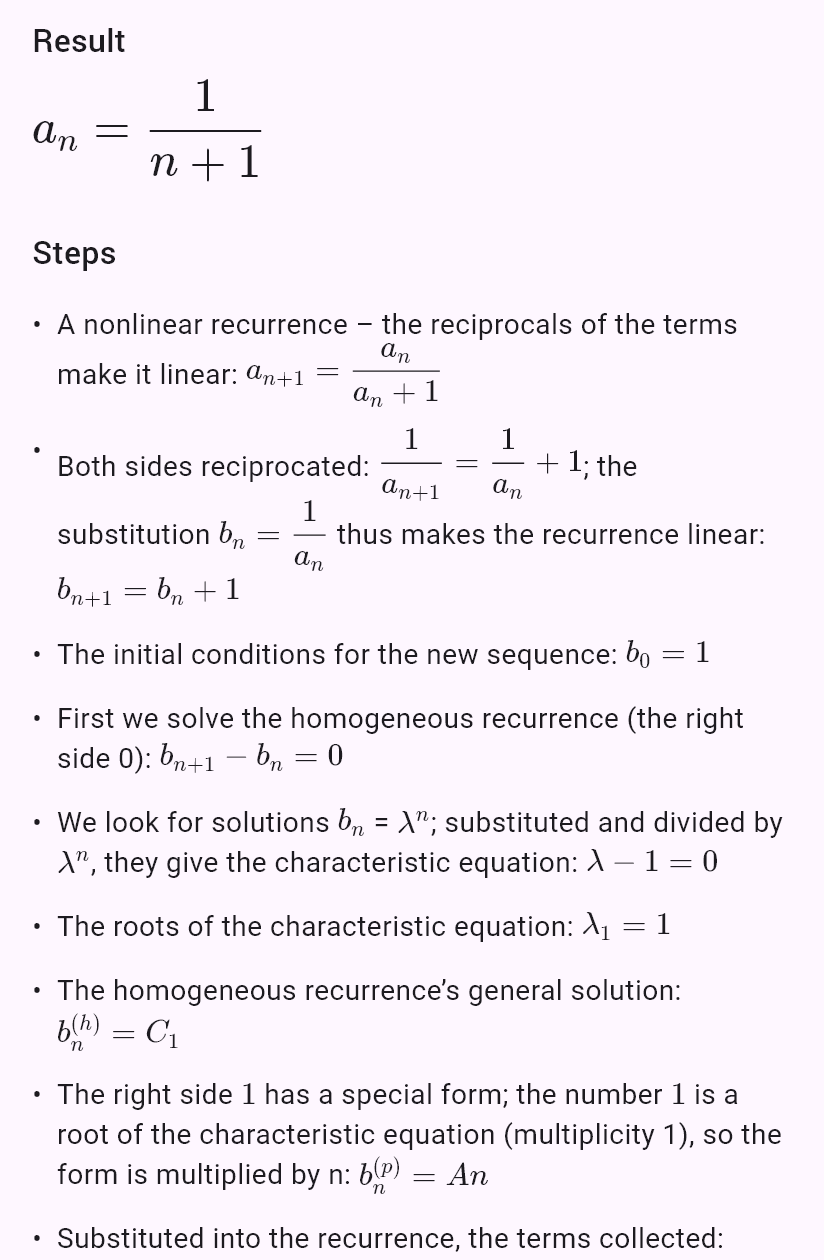
The “Method” chip offers the generating function too (A(x) = Σ aₙxⁿ, partial fractions, geometric series), matrix powers (diagonalization) or, for the first order, summing. A first-order recurrence with a variable coefficient (aₙ₊₁ = (n + 1)aₙ) is solved by a product (factorials), convertible nonlinear recurrences by the substitution bₙ = 1/aₙ or bₙ = ln aₙ. A system of two recurrences is solved by eliminating one sequence or by the matrix, a divide-and-conquer recurrence T(n) = aT(n/b) + f(n) by n = bᵏ – with the master theorem's estimate.
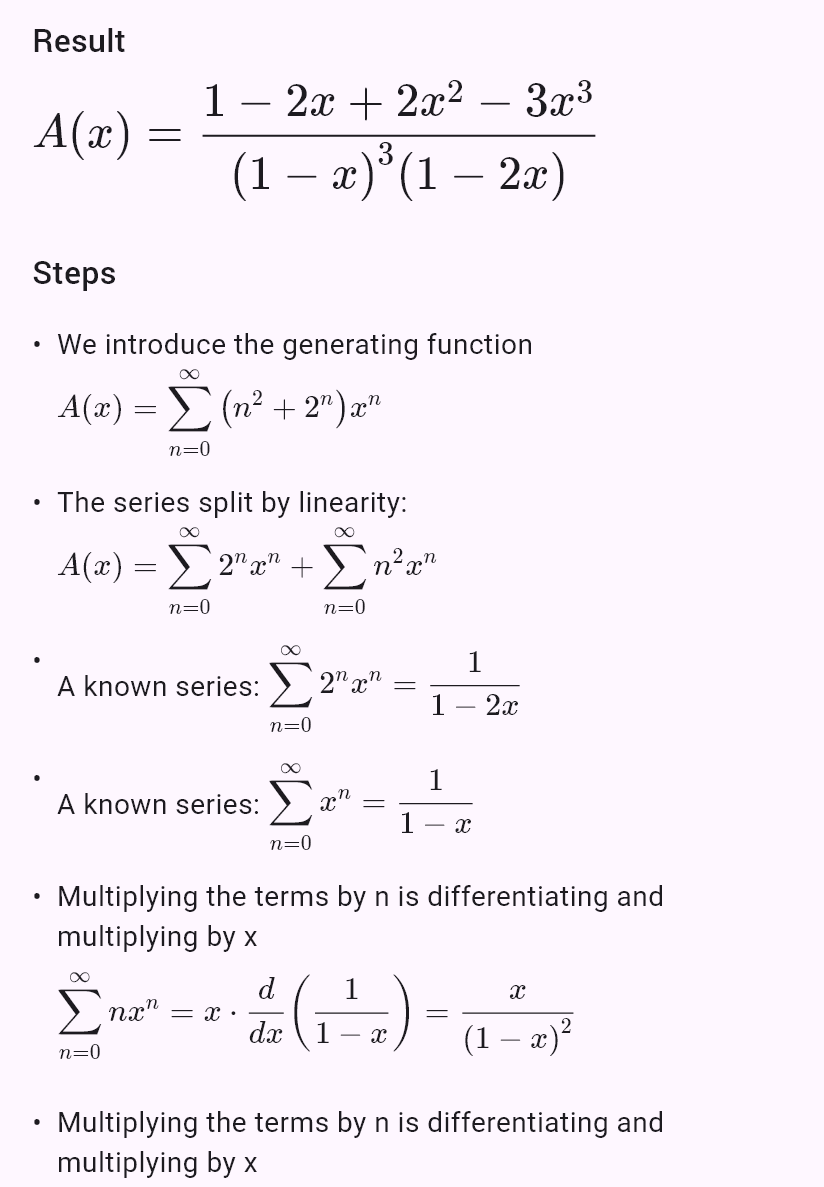
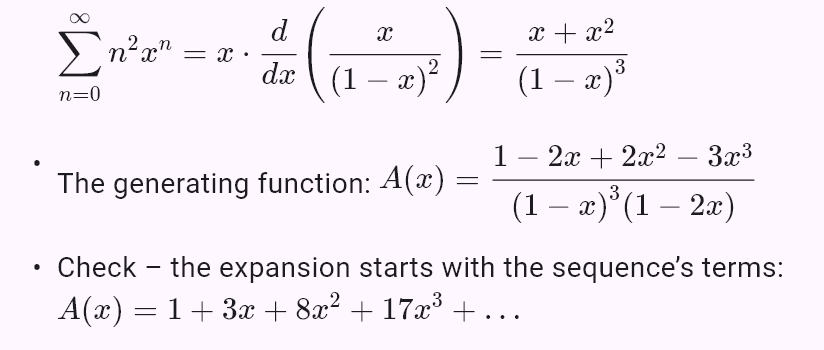
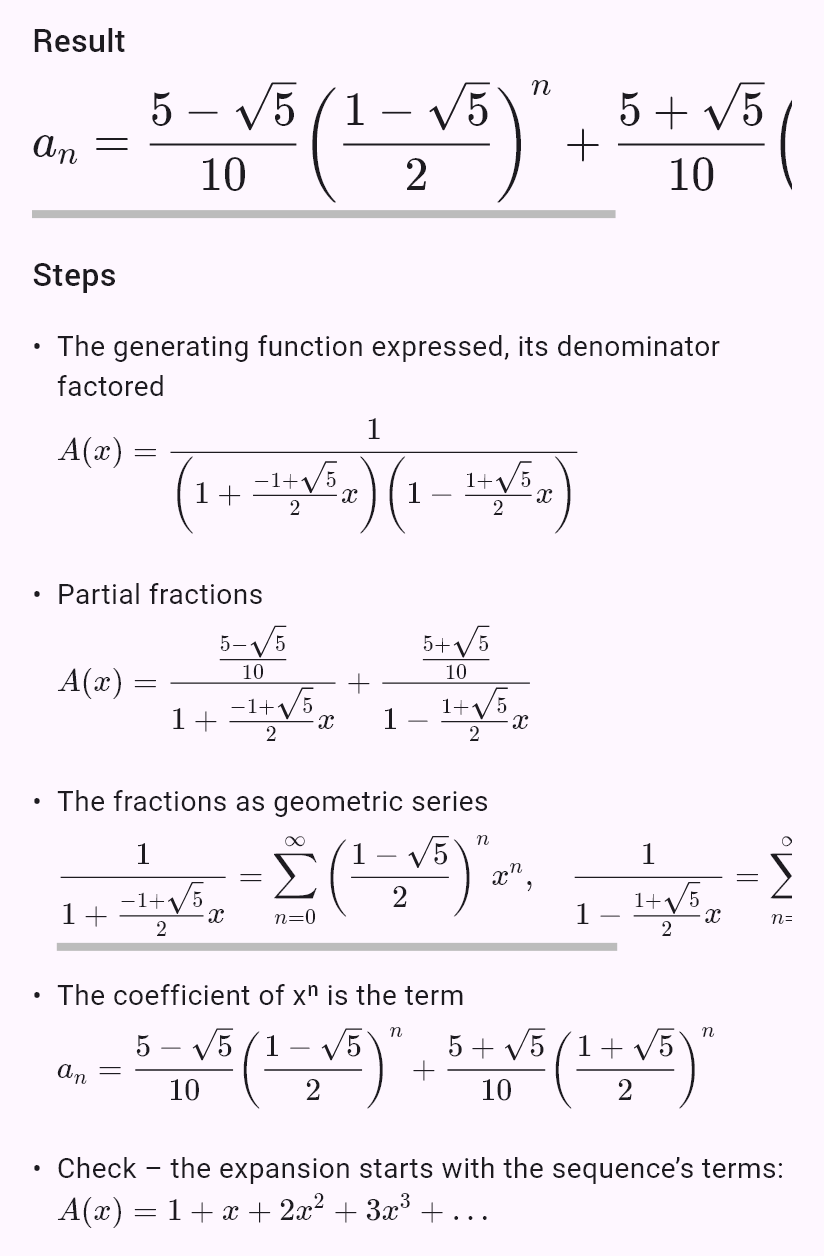
With the “Generating function” operation the app finds the generating function of a sequence given by a formula (n² + 2ⁿ) or by its first terms (1, 0, 1, 0, …), and conversely the formula for aₙ from a function A(x). The number of non-negative whole solutions of x₁ + x₂ + … = N (also with bounds or coefficients – paying with coins) is the coefficient of a generating function.
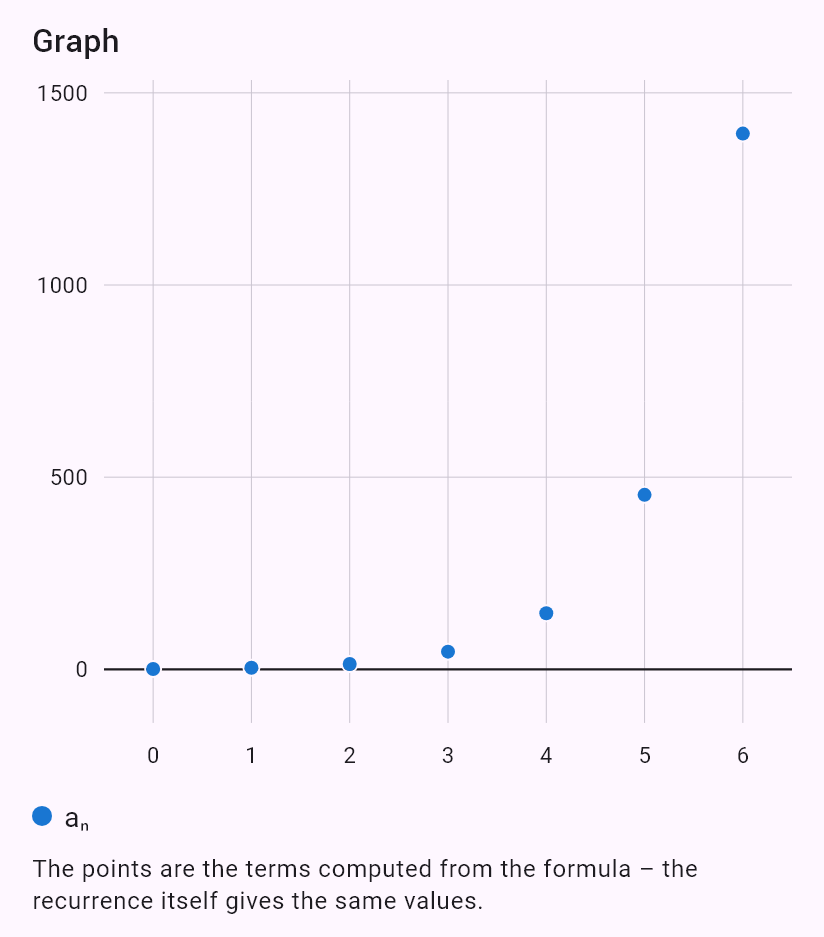
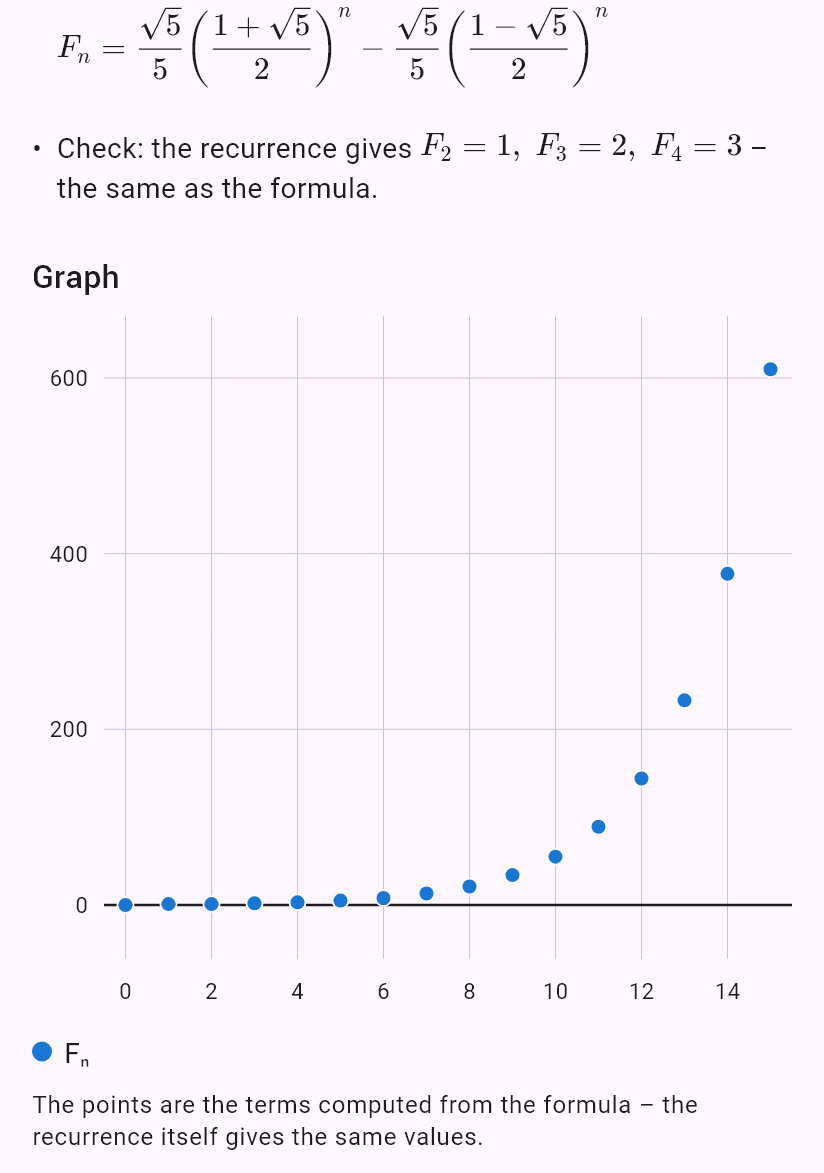
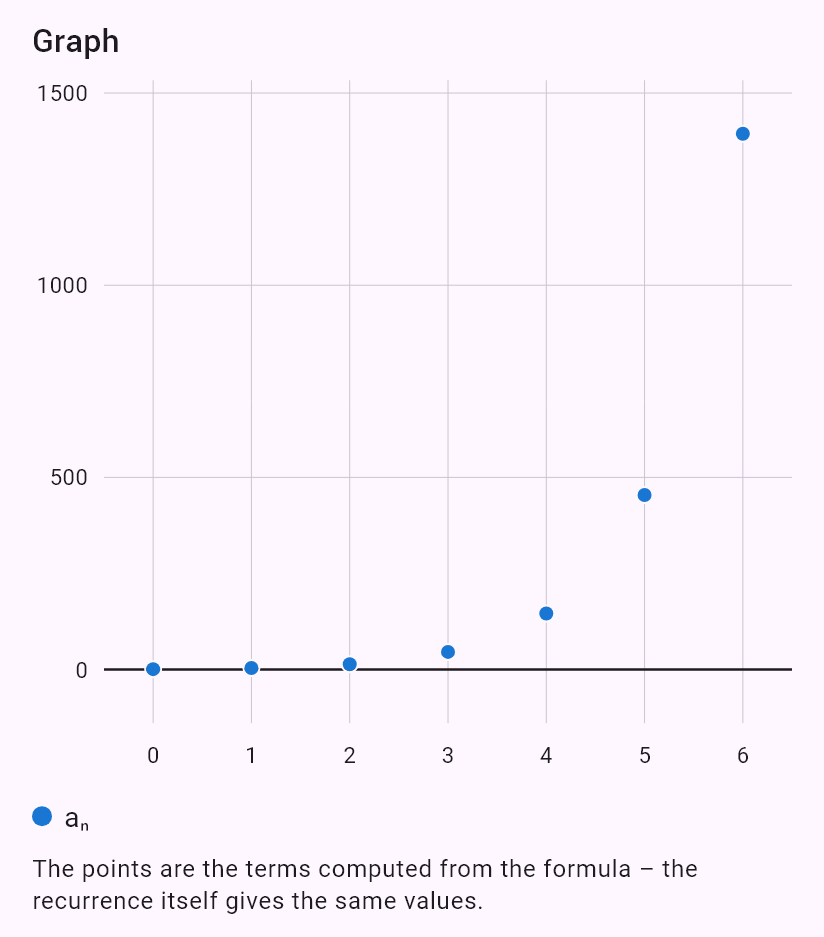
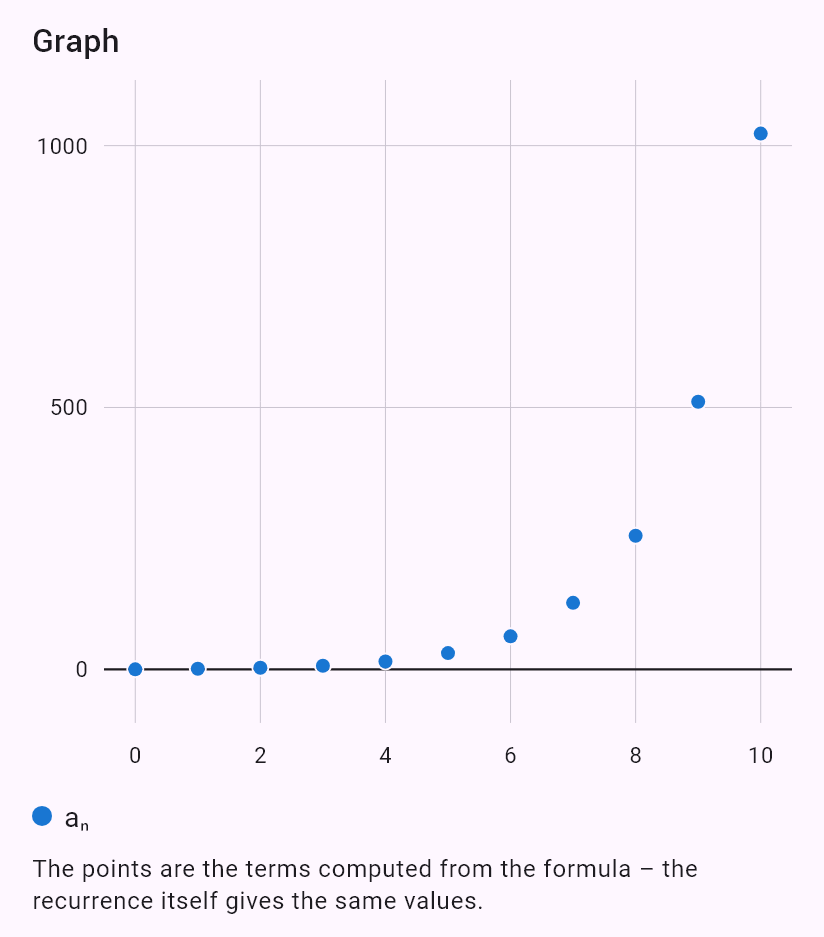
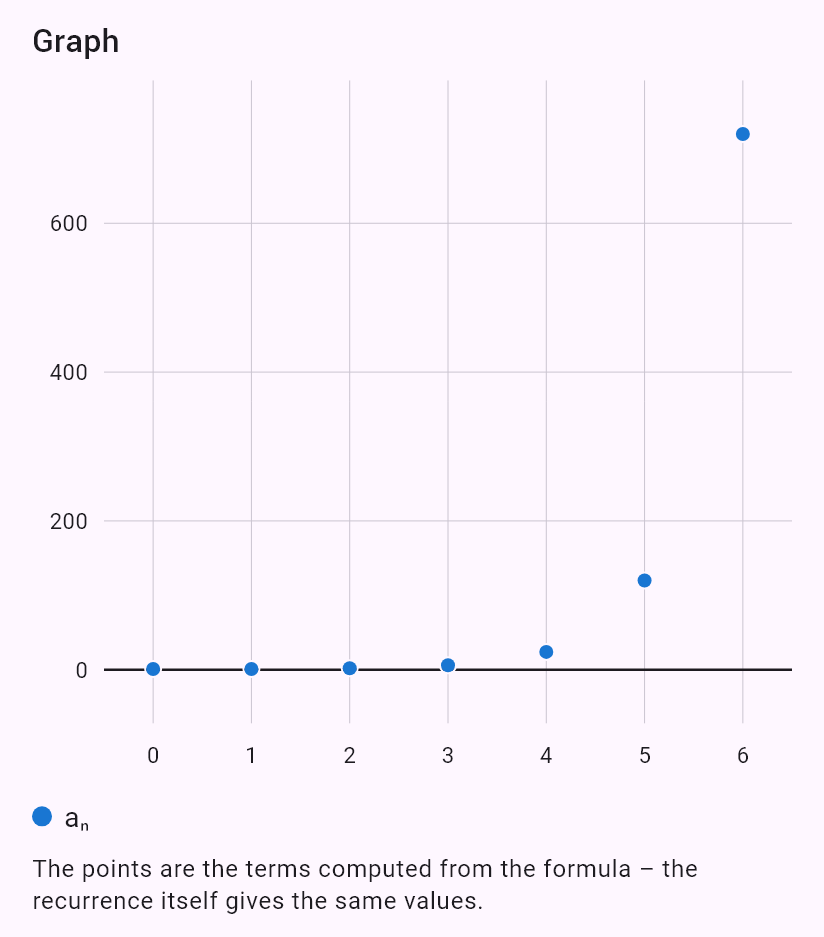
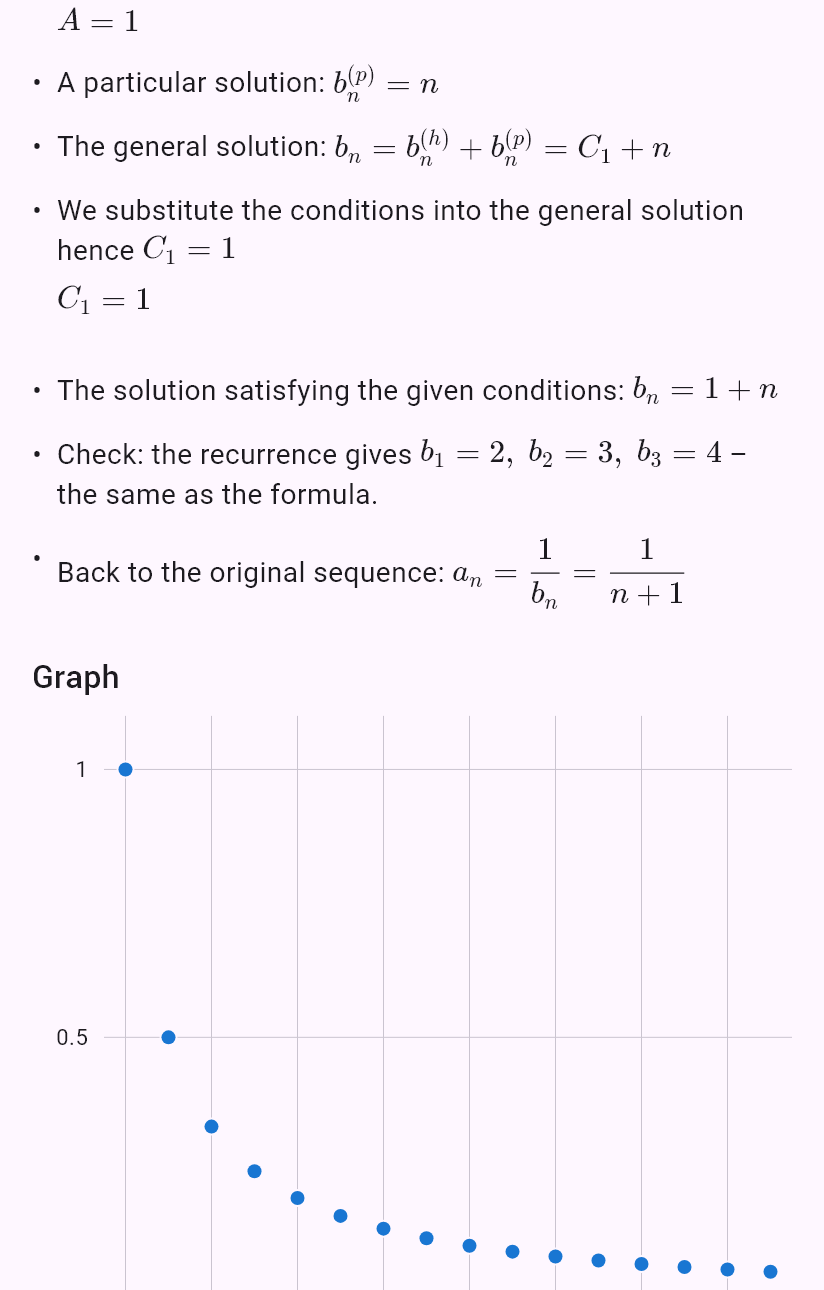
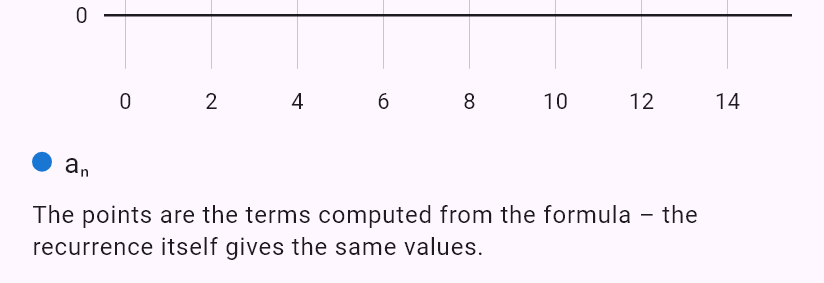
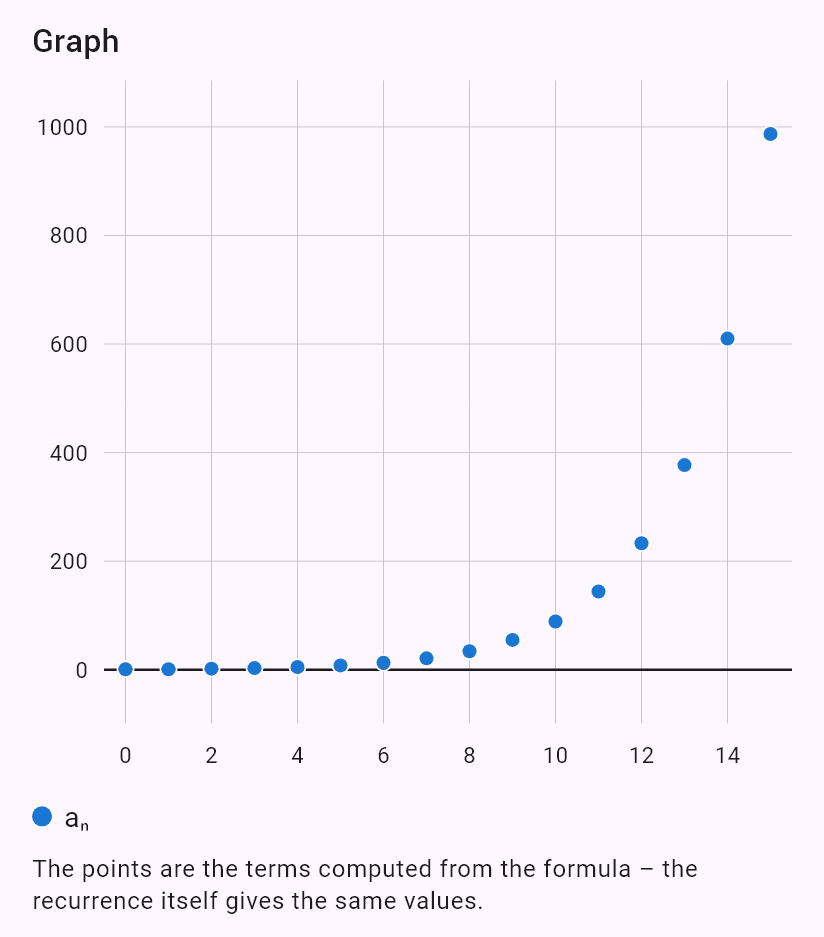
The graph shows the terms of the sequence as points (both sequences of a system).
How to enter it
a(n+2) = 5a(n+1) - 6a(n), a(0) = 1, a(1) = 4 | Brackets, the conditions after a comma. |
a_{n+2} = 5a_{n+1} - 6a_n | Subscripts (also from a photo). Without conditions: the general solution with constants C₁, C₂. |
F_n = F_{n-1} + F_{n-2}, F_1 = F_2 = 1 | The index may go down (aₙ₋₁, aₙ₋₂); one value can be given to several terms. |
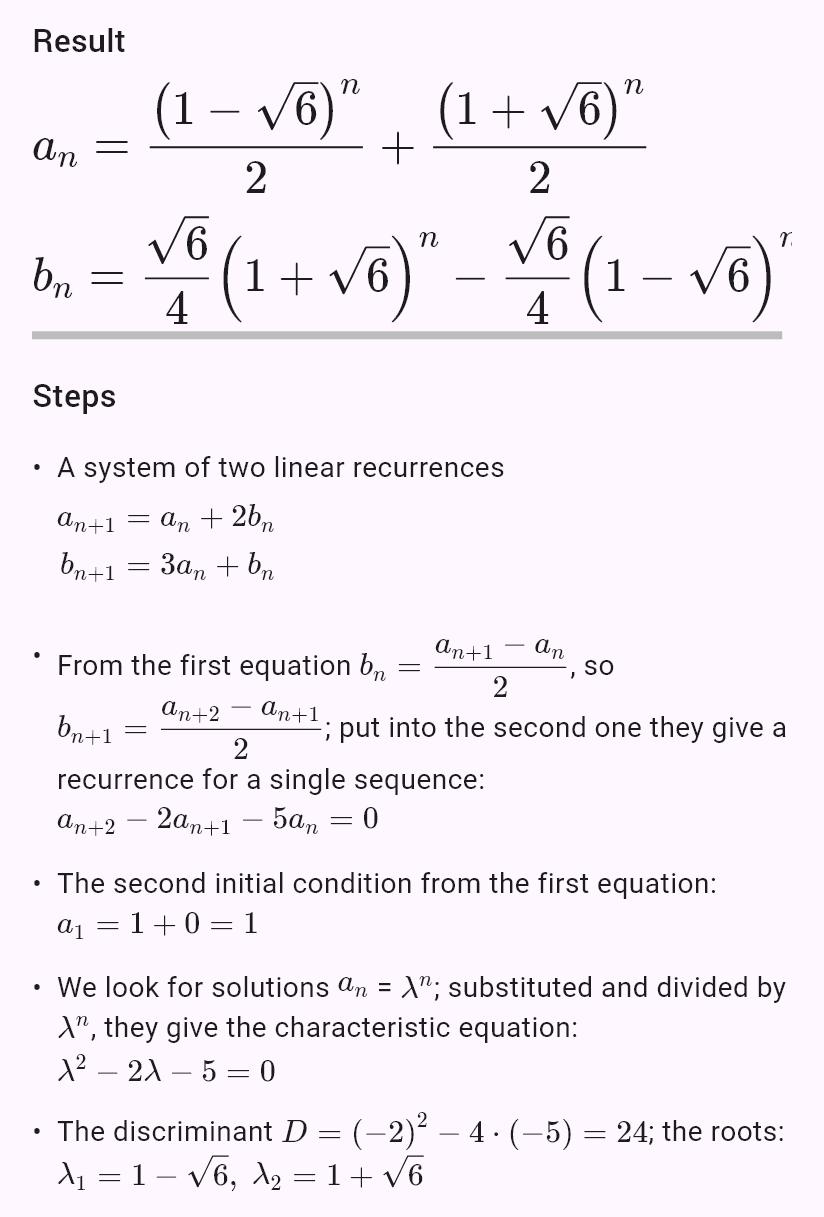
a_{n+1} = a_n + 2b_n | A system – the equations on lines, the conditions on the last one. |
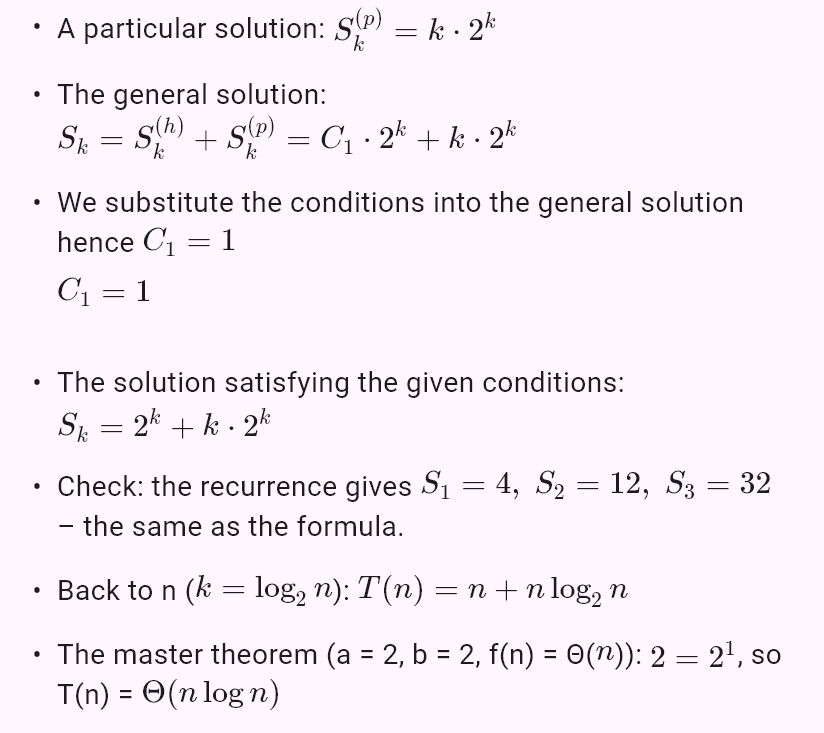
T(n) = 2T(n/2) + n, T(1) = 1 | Divide and conquer – a term at n/b. |
n^2 + 2^n | A sequence's formula with the “Generating function” operation (also aₙ = …). |
1, 0, 1, 0, ... | The first terms separated by commas. |
1/(1 - x - x^2) | A generating function in x (also A(x) = …) – the formula for aₙ. |
number of solutions x_1 + x_2 + x_3 = 10, x_1 <= 3 | The number of non-negative whole solutions with bounds. |
Examples
a_{n+2} = 5a_{n+1} - 6a_n, a_0 = 1, a_1 = 4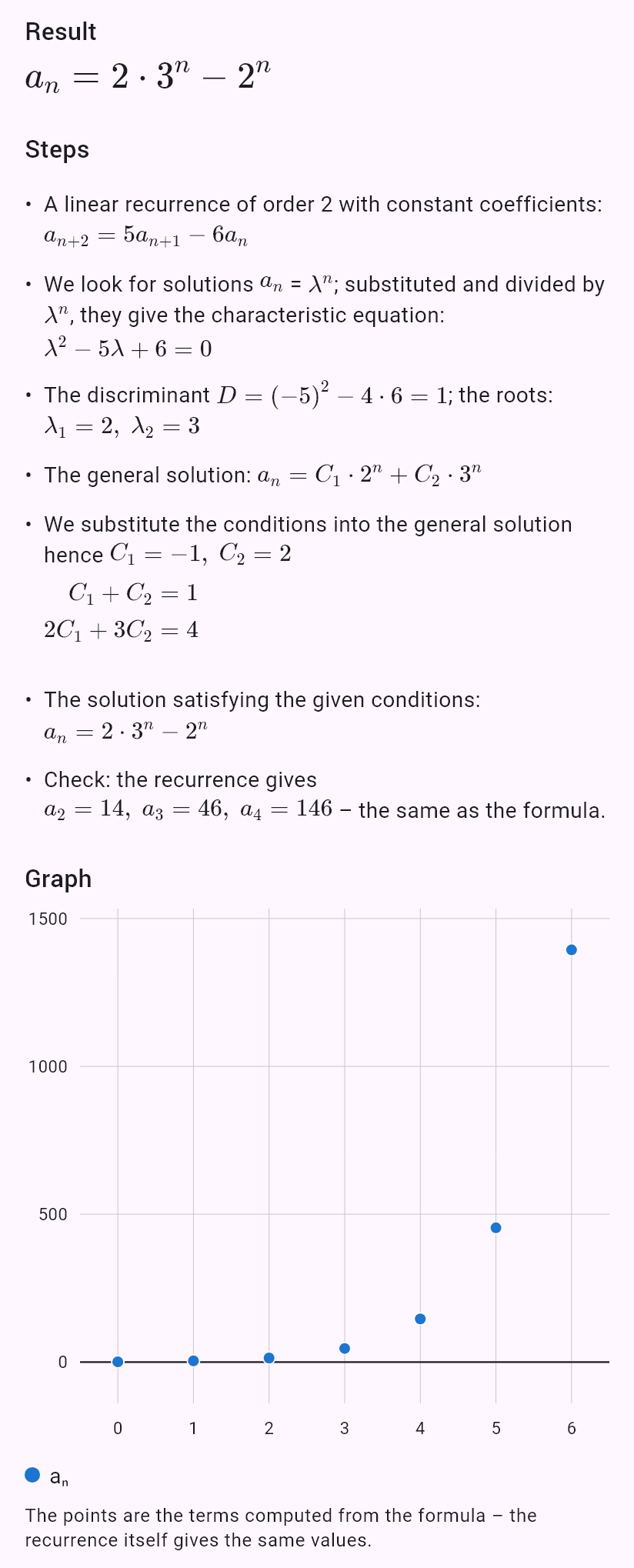
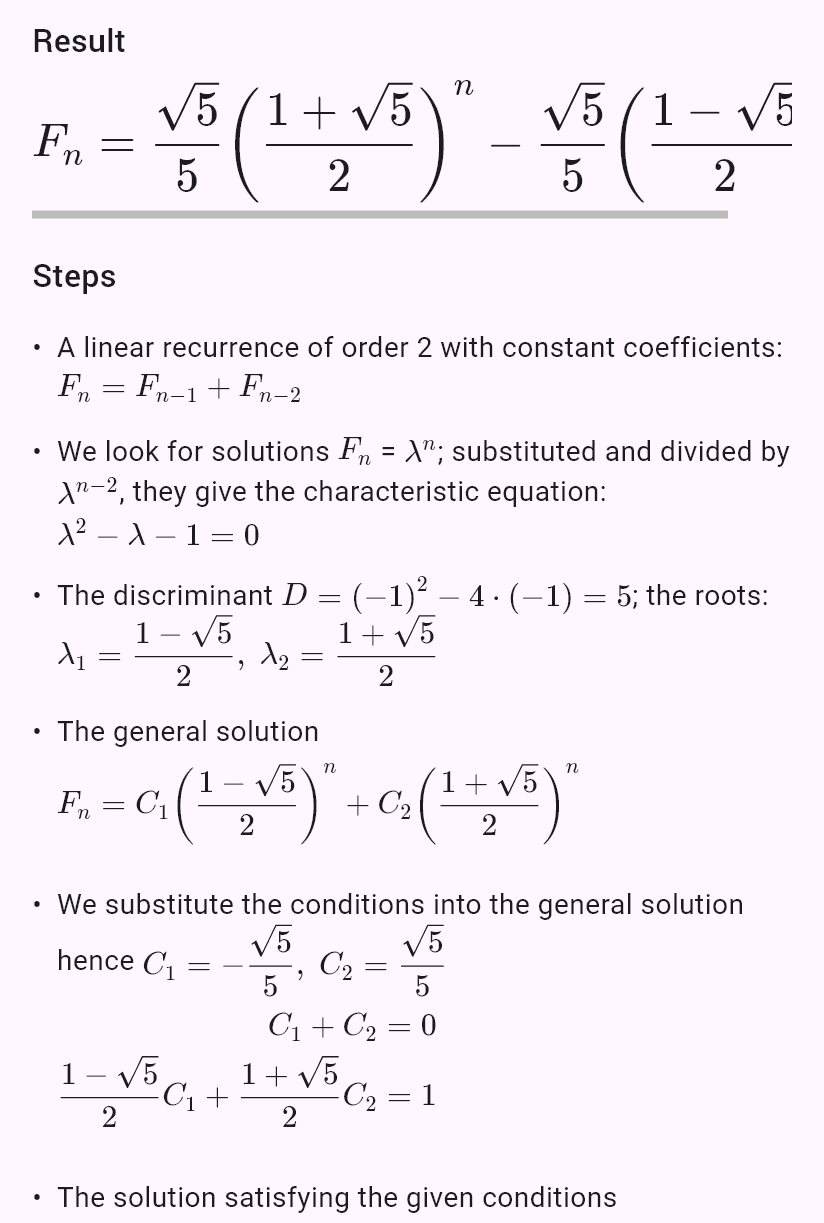
F_n = F_{n-1} + F_{n-2}, F_0 = 0, F_1 = 1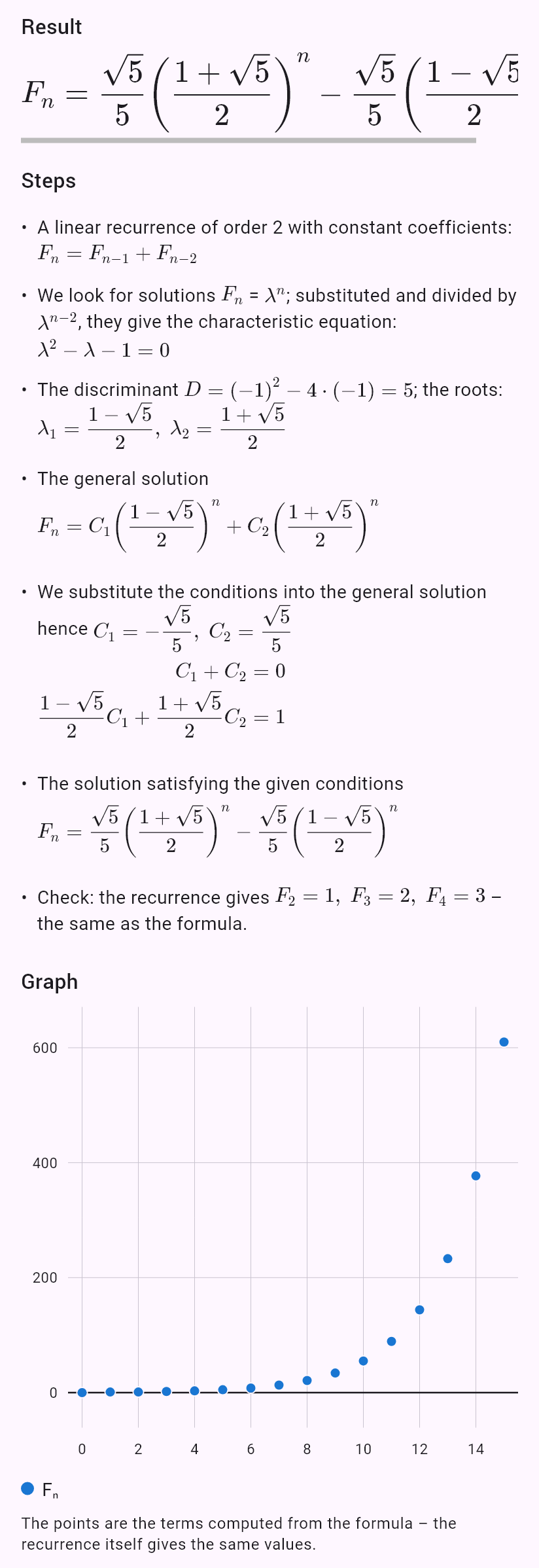
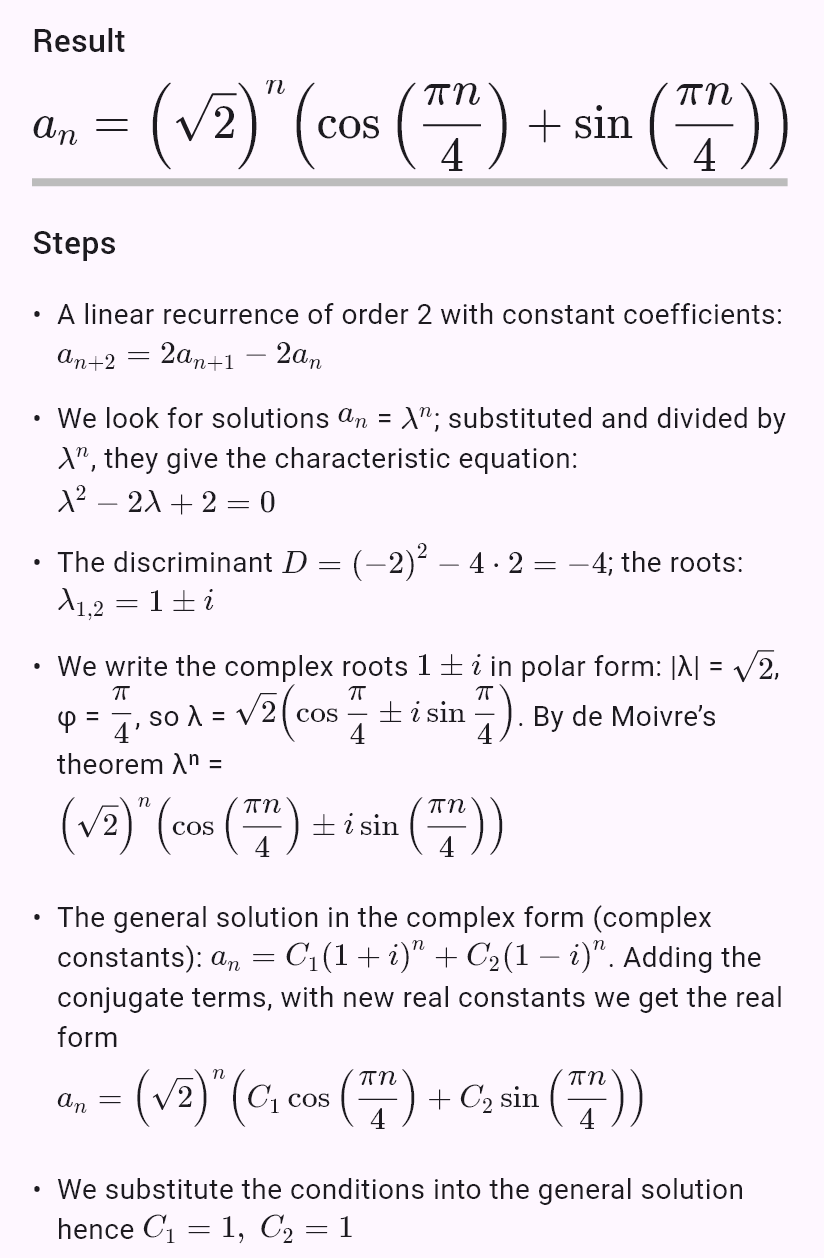
a_{n+2} = 2a_{n+1} - 2a_n, a_0 = 1, a_1 = 2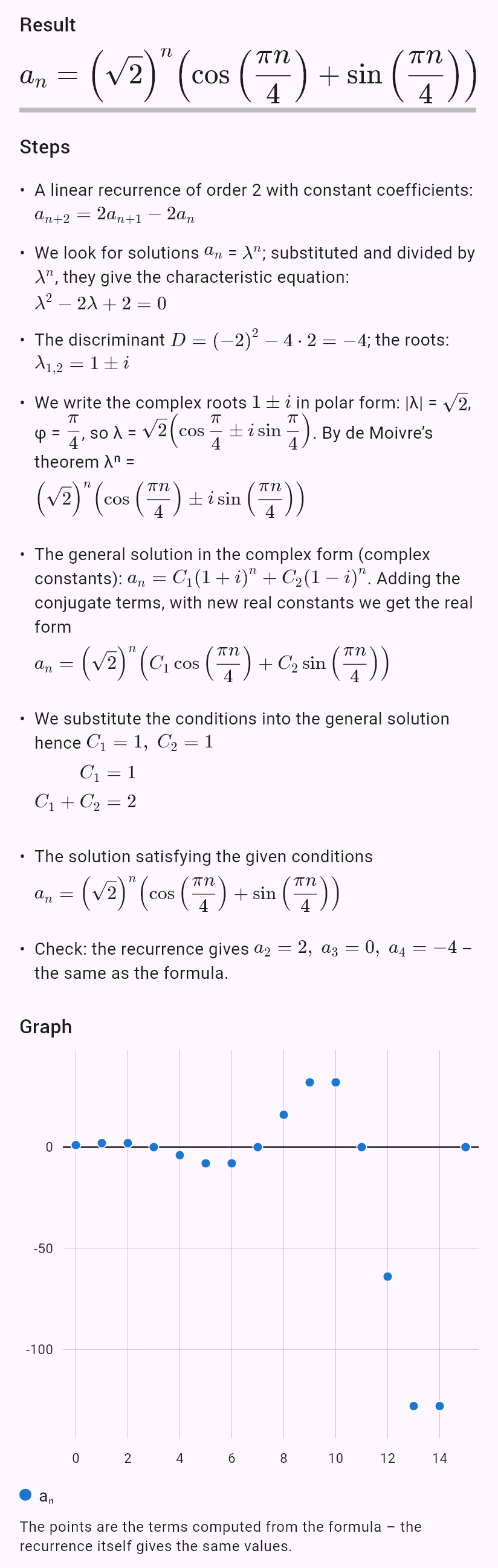
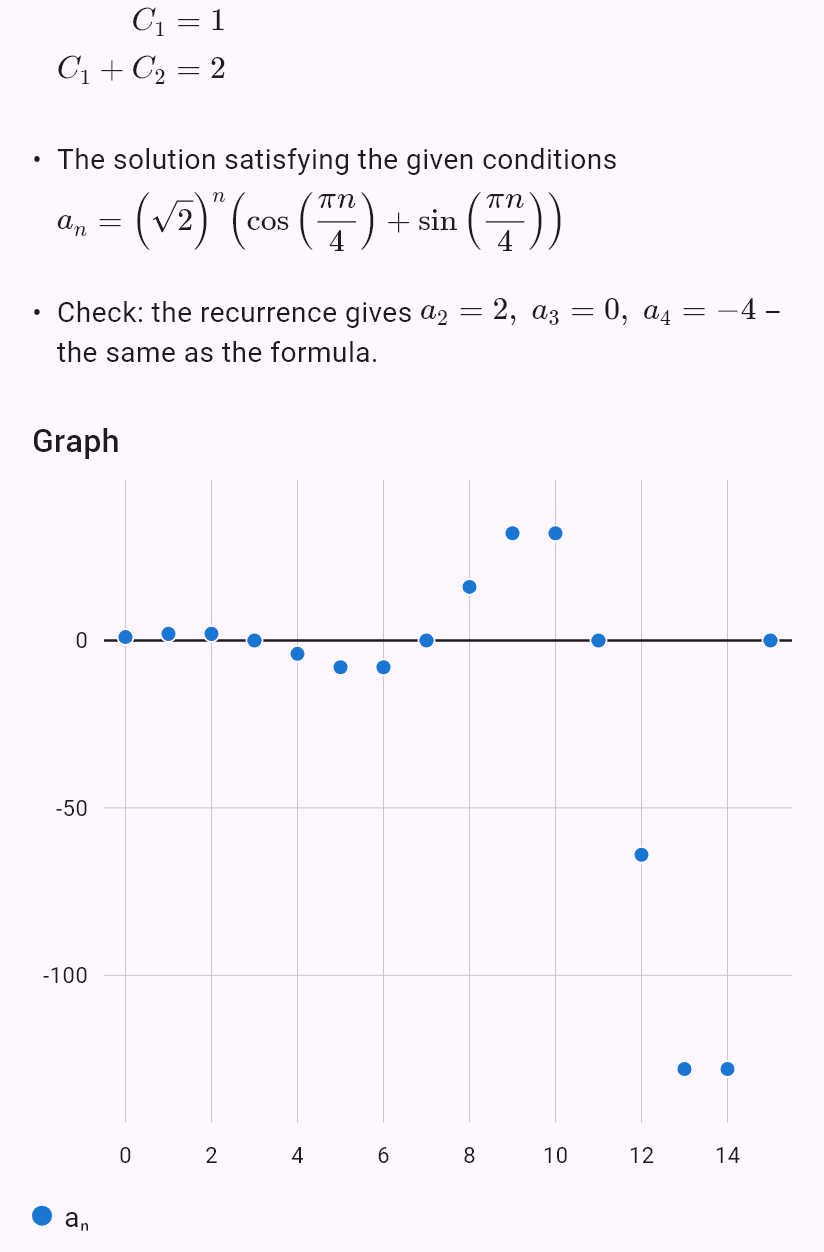

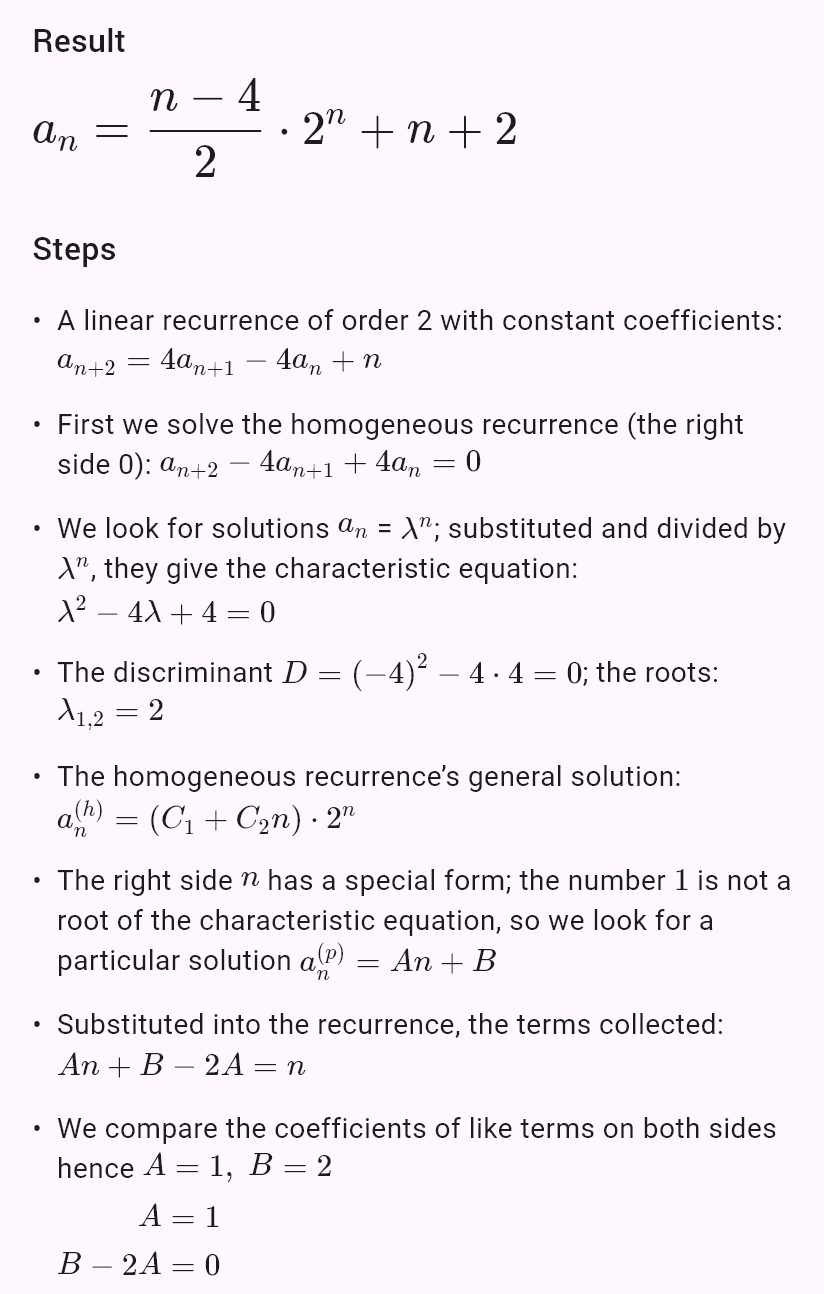
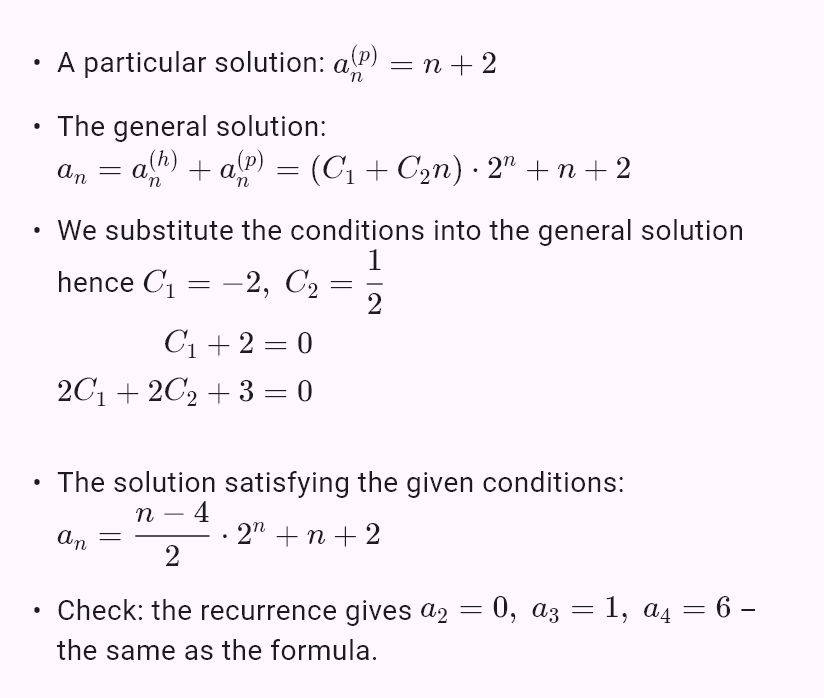
a_{n+2} = 4a_{n+1} - 4a_n + n, a_0 = 0, a_1 = 0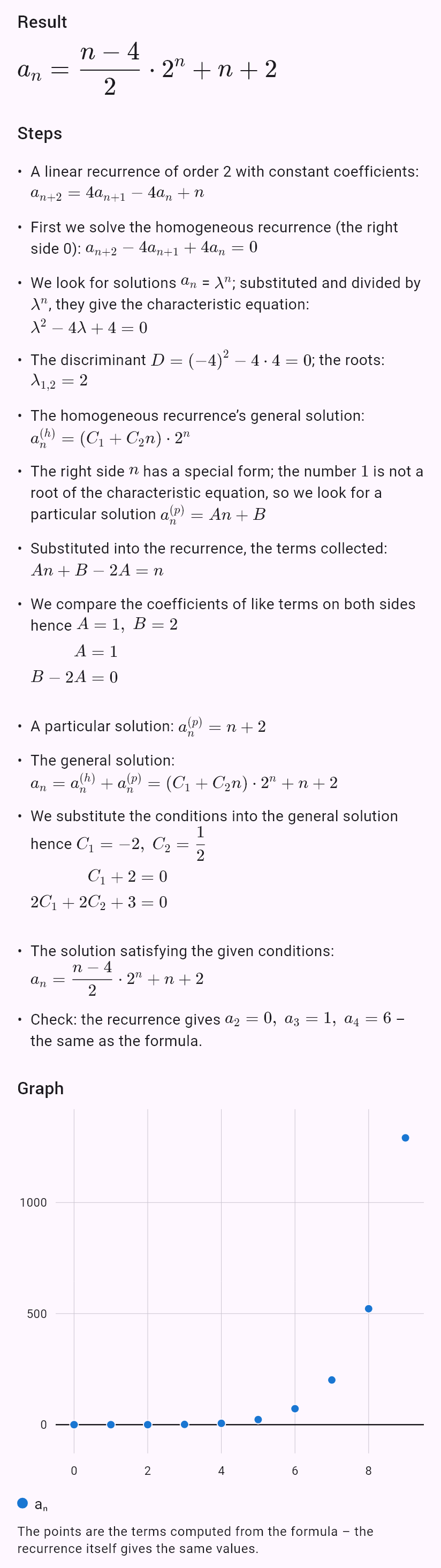
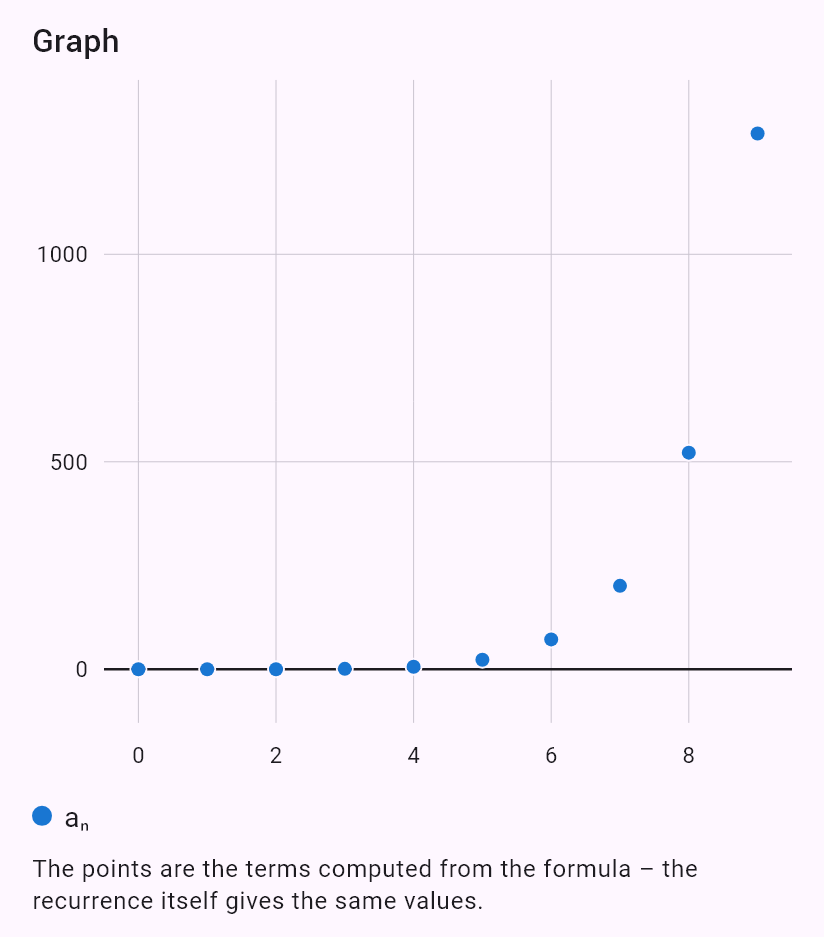
a_{n+2} = 5a_{n+1} - 6a_n, a_0 = 1, a_1 = 4 Generating function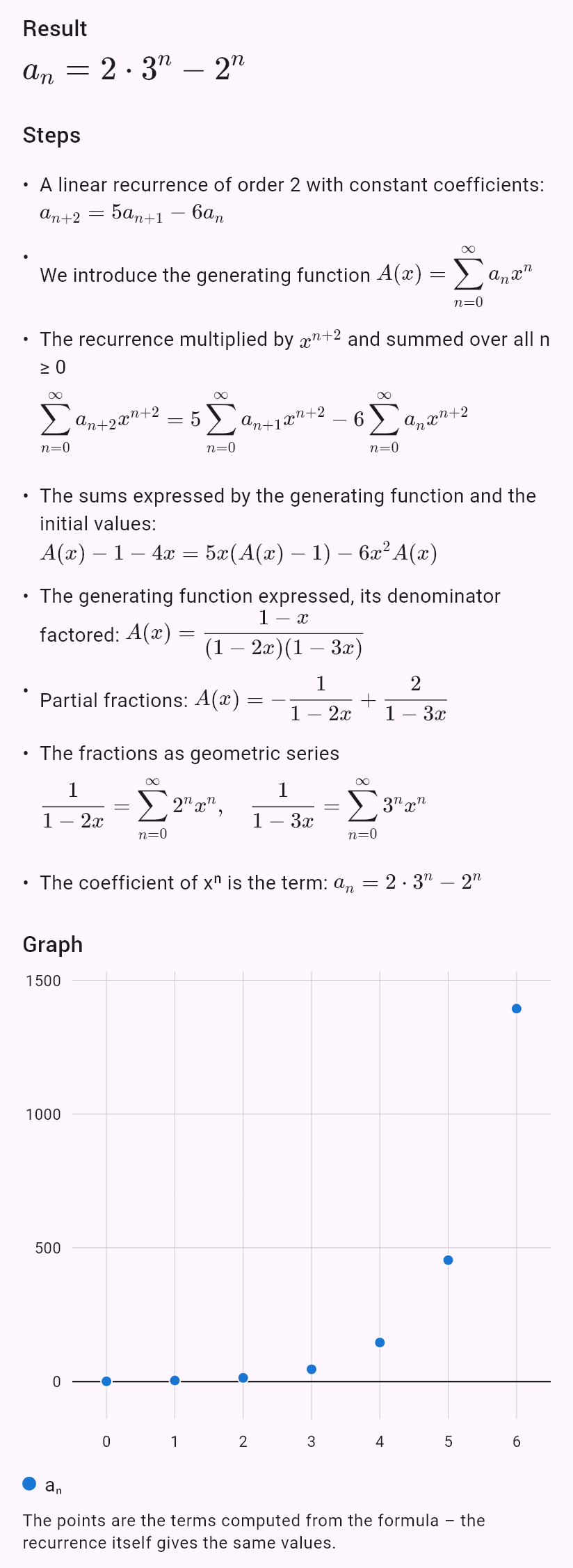
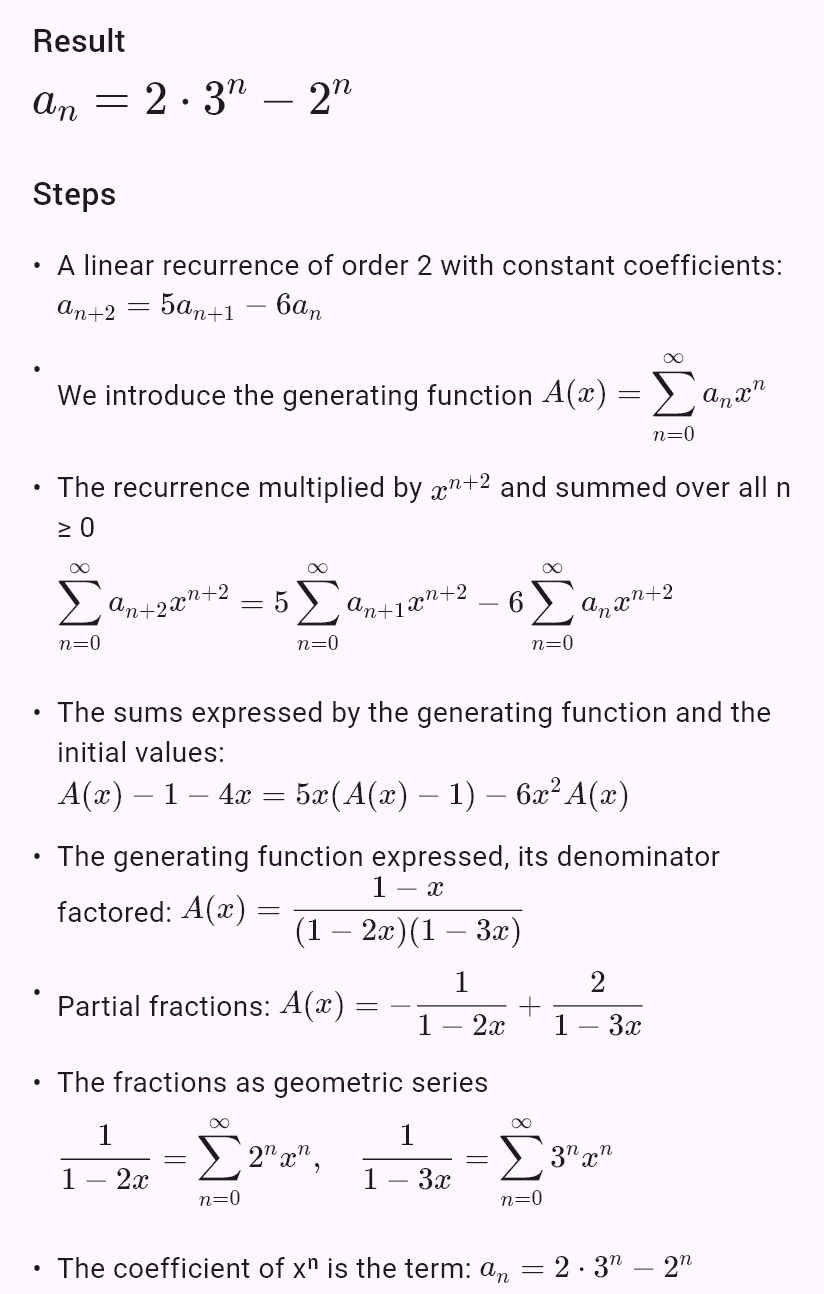
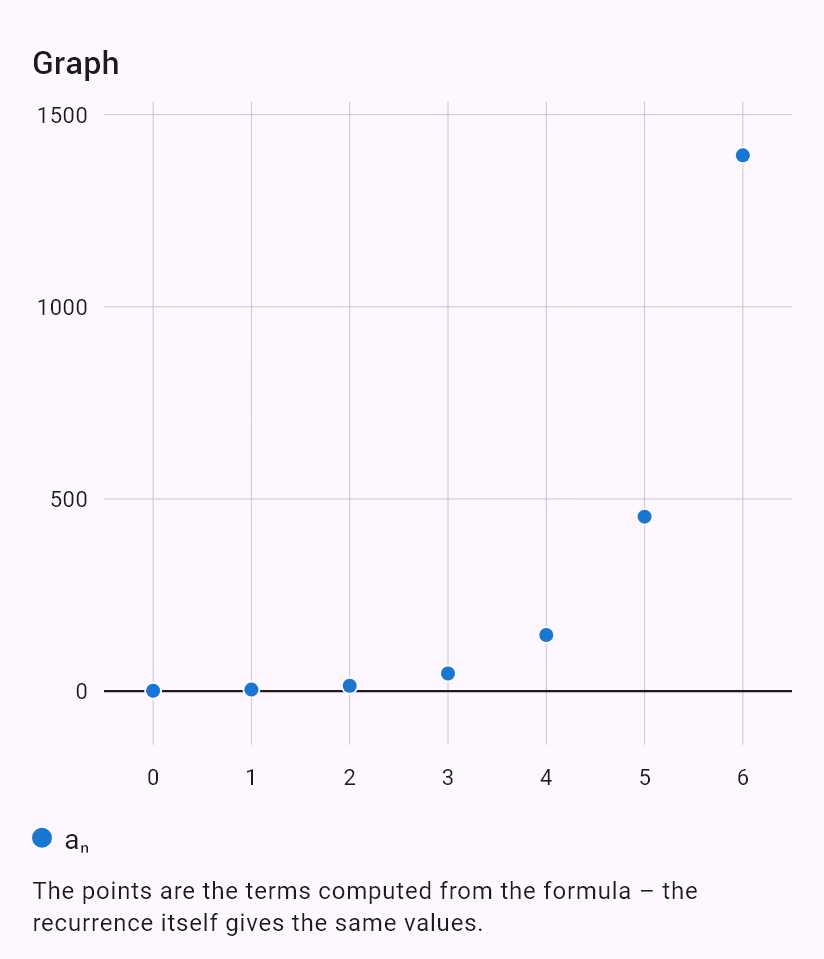
a_{n+2} = 5a_{n+1} - 6a_n, a_0 = 1, a_1 = 4 Matrix powers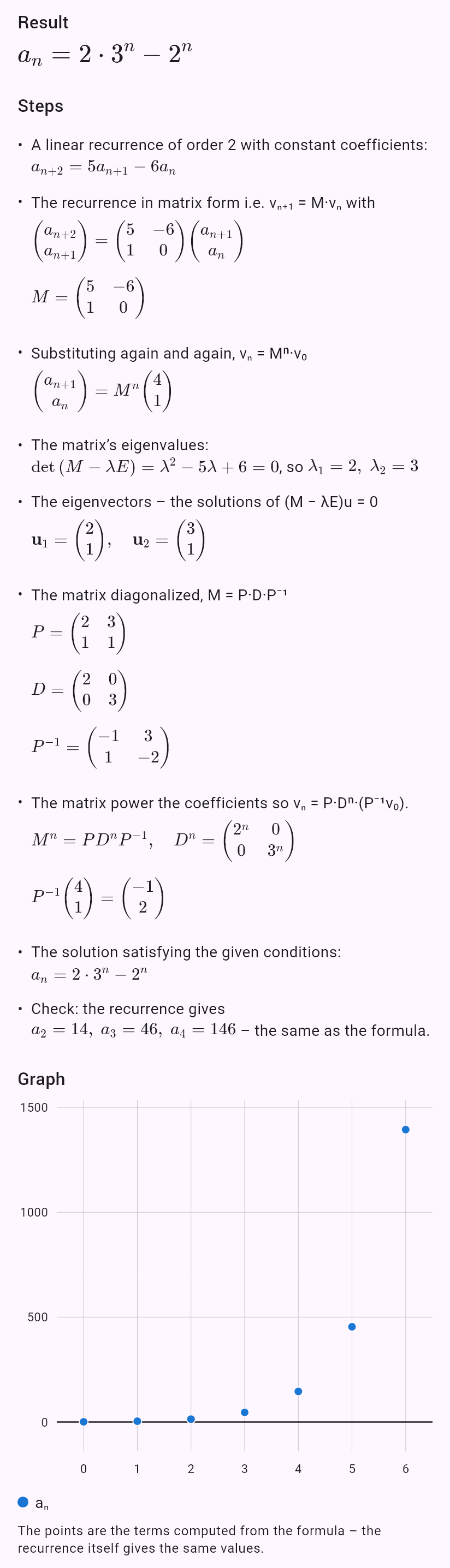
a_{n+1} = 2a_n + 1, a_0 = 0 Summing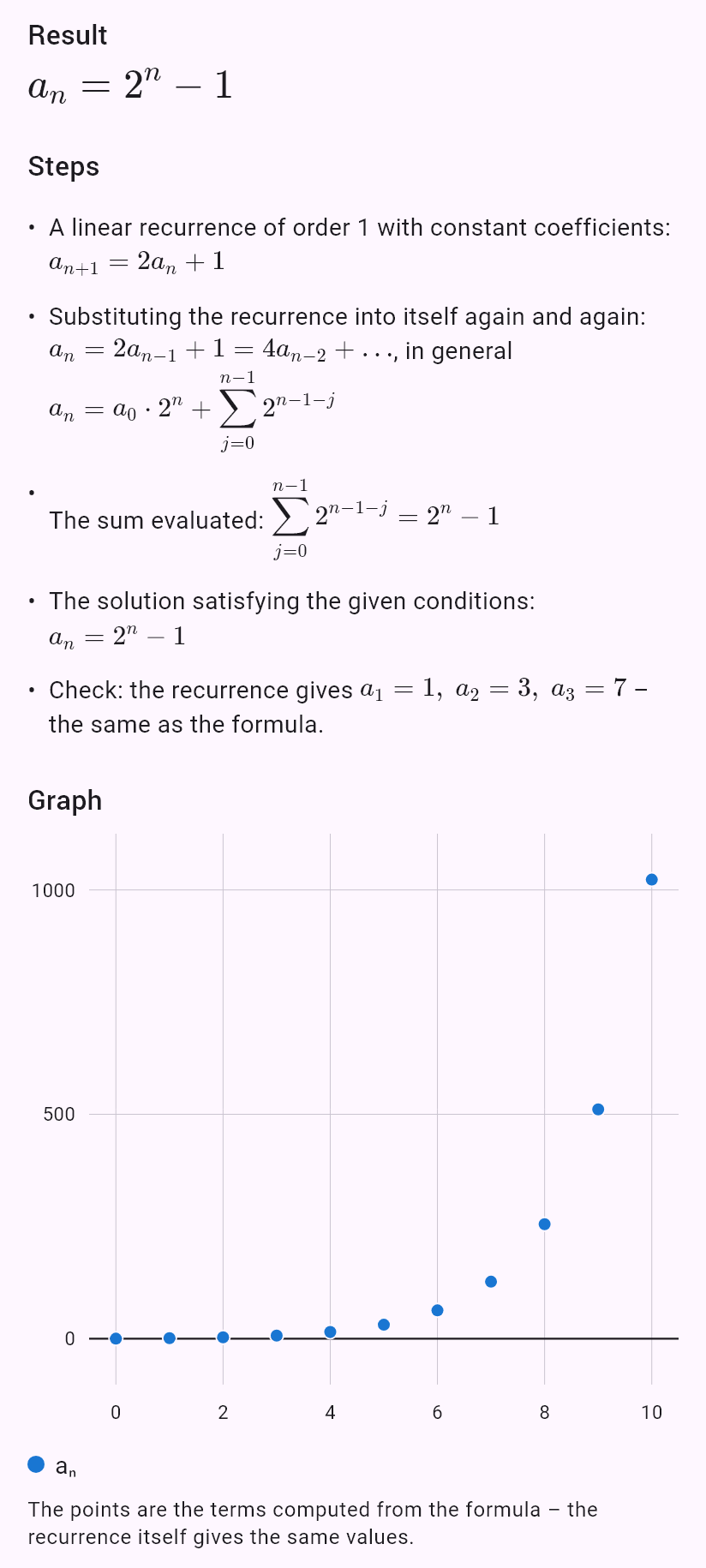
a_{n+1} = (n+1)a_n, a_0 = 1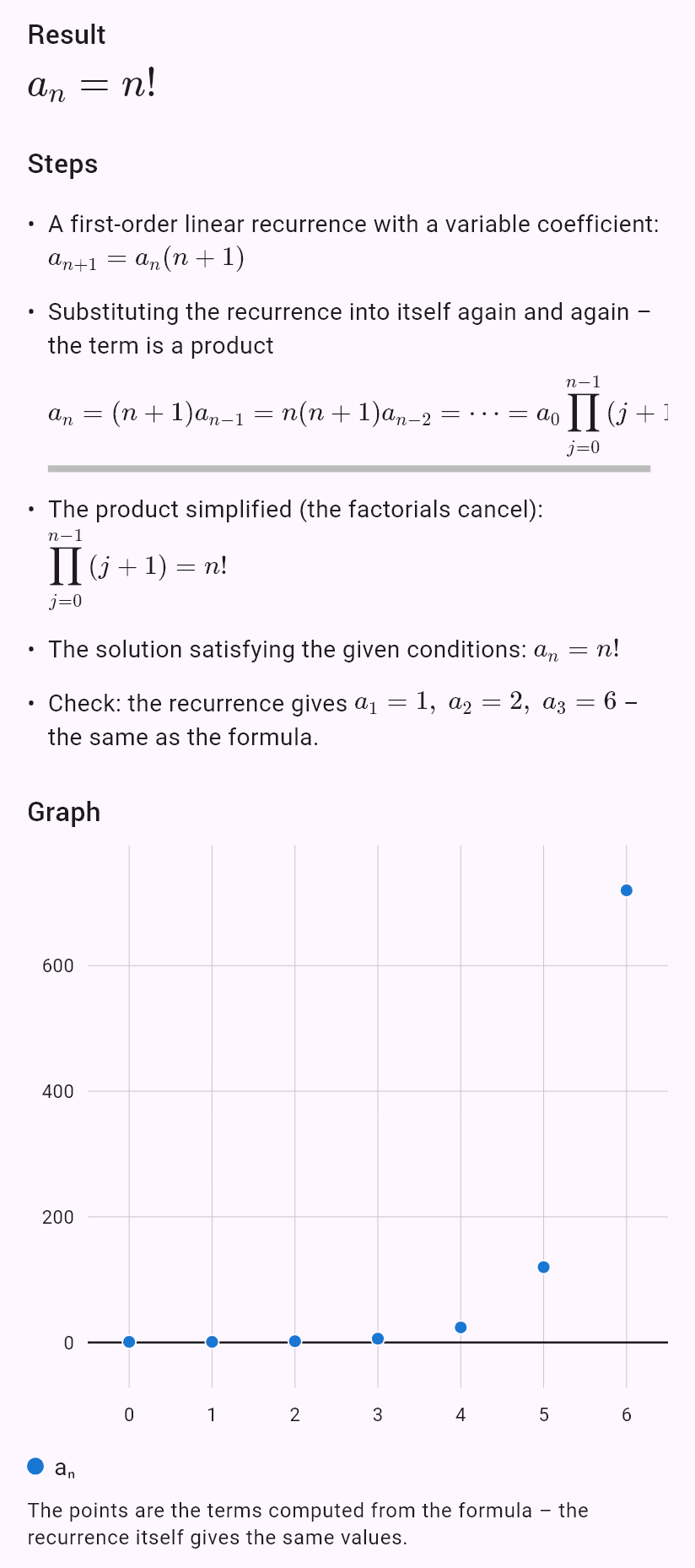
a_{n+1} = a_n/(1 + a_n), a_0 = 1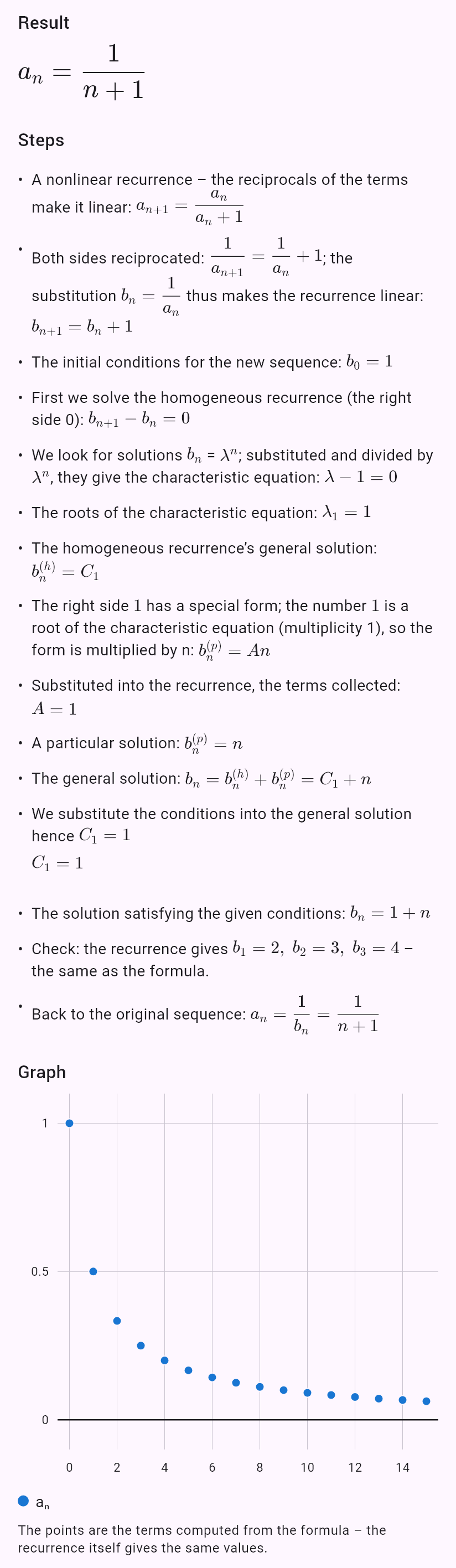
a_{n+1} = a_n + 2b_n
b_{n+1} = 3a_n + b_n
a_0 = 1, b_0 = 0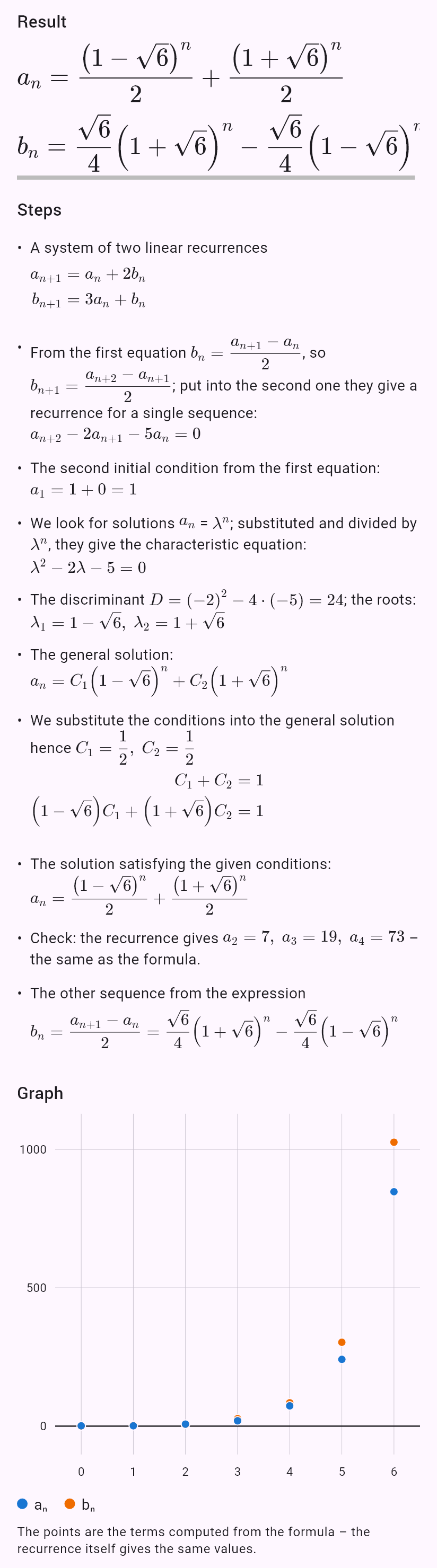
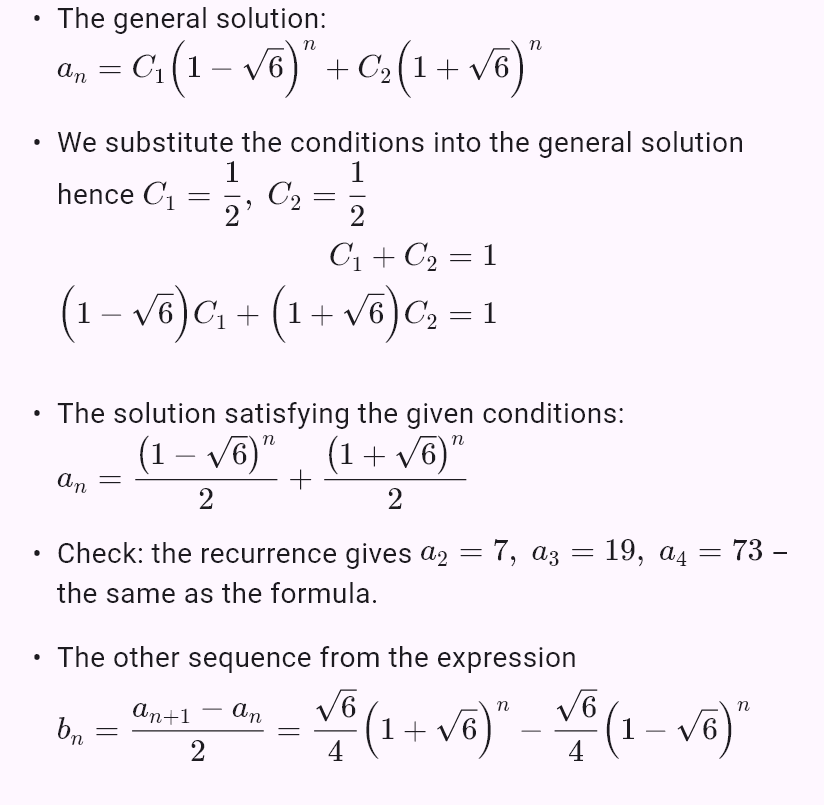
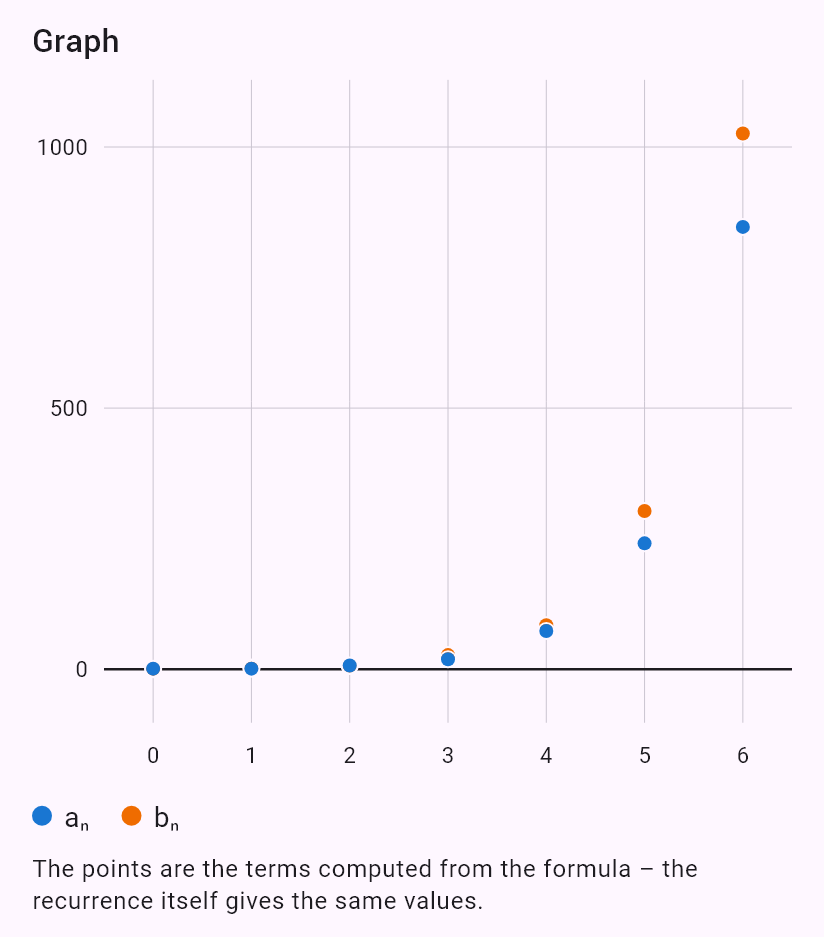
T(n) = 2T(n/2) + n, T(1) = 1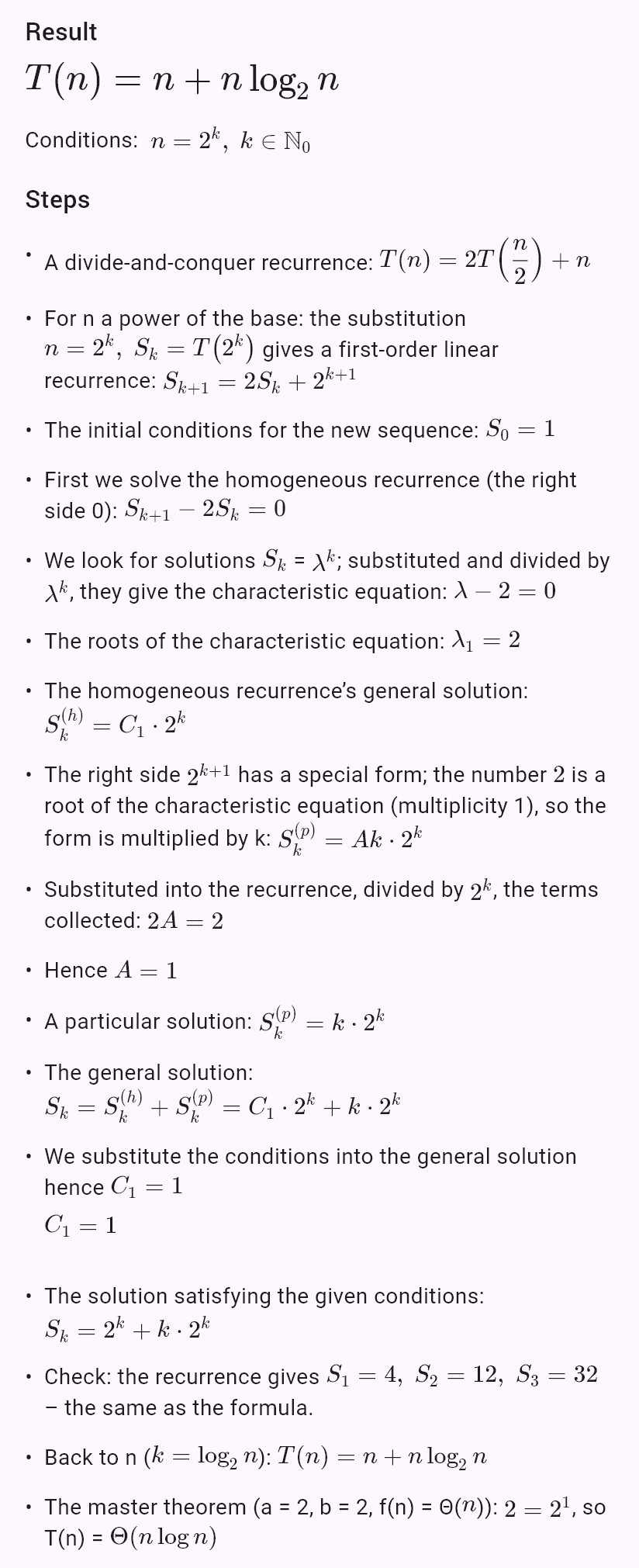
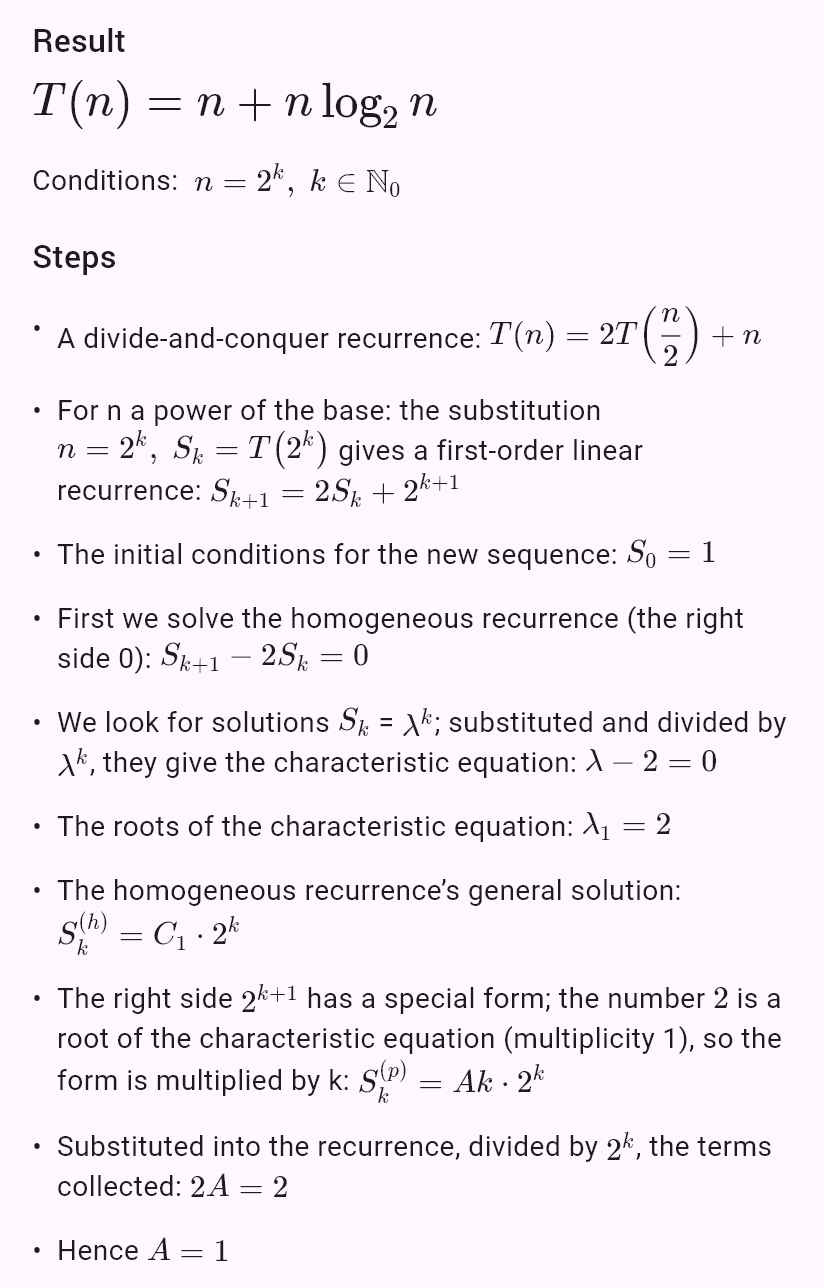
n^2 + 2^n Generating function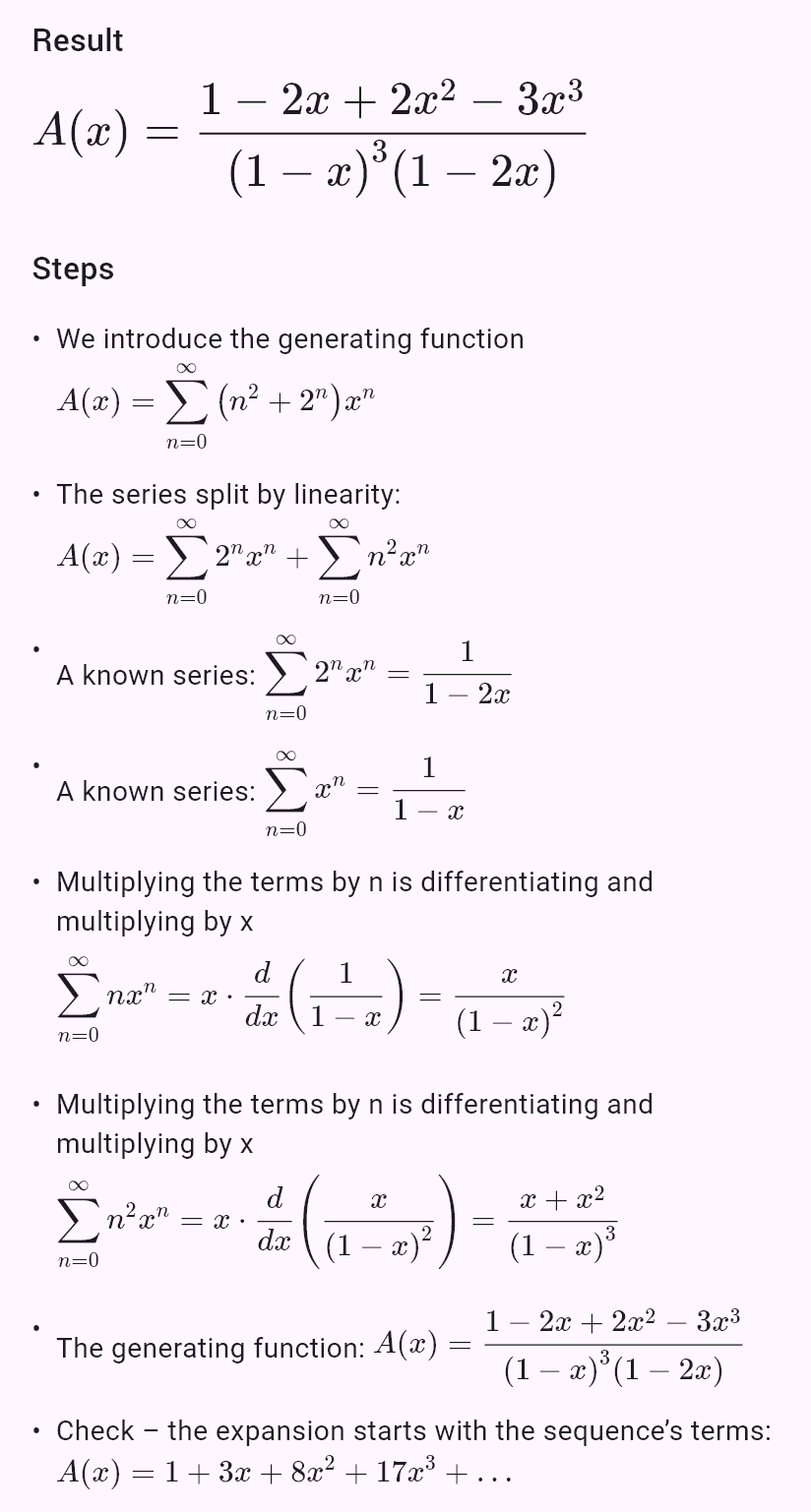
1/(1 - x - x^2) Generating function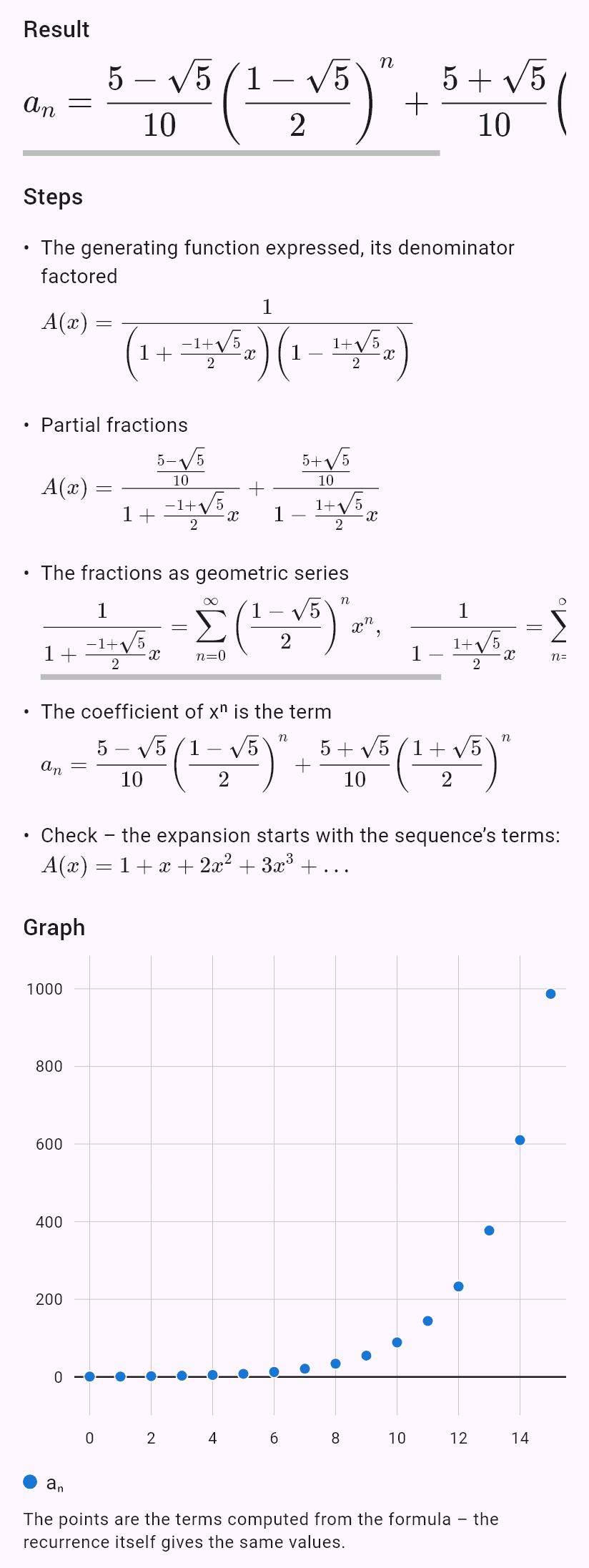
number of solutions x_1 + x_2 + x_3 = 10, x_1 <= 3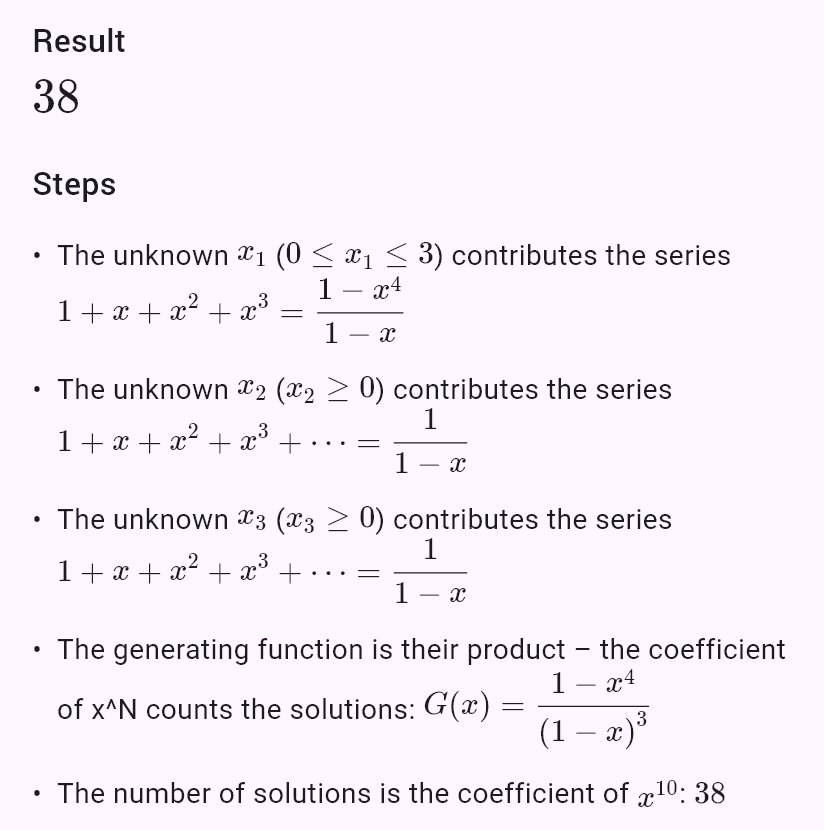
Known limitations
- Not yet: higher-order linear recurrences with variable coefficients, systems of three or more recurrences, divide and conquer with several terms (T(n/2) and T(n/3)) and nonlinear recurrences these substitutions don't make linear.