Derivatives
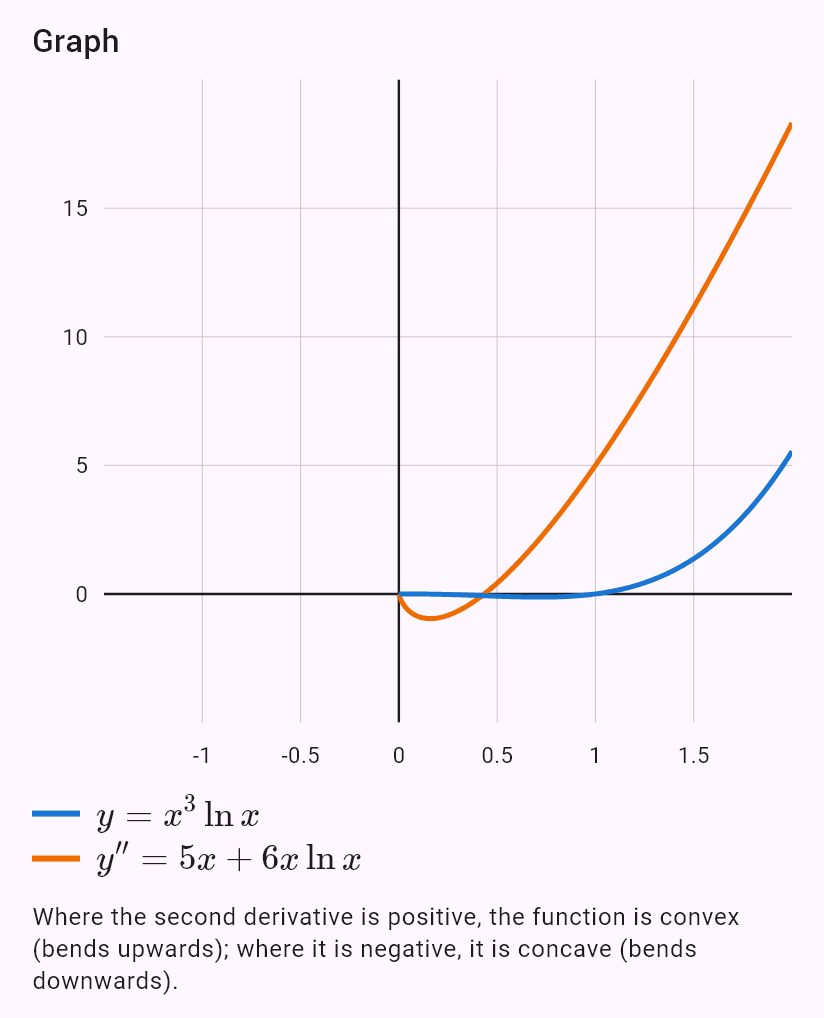
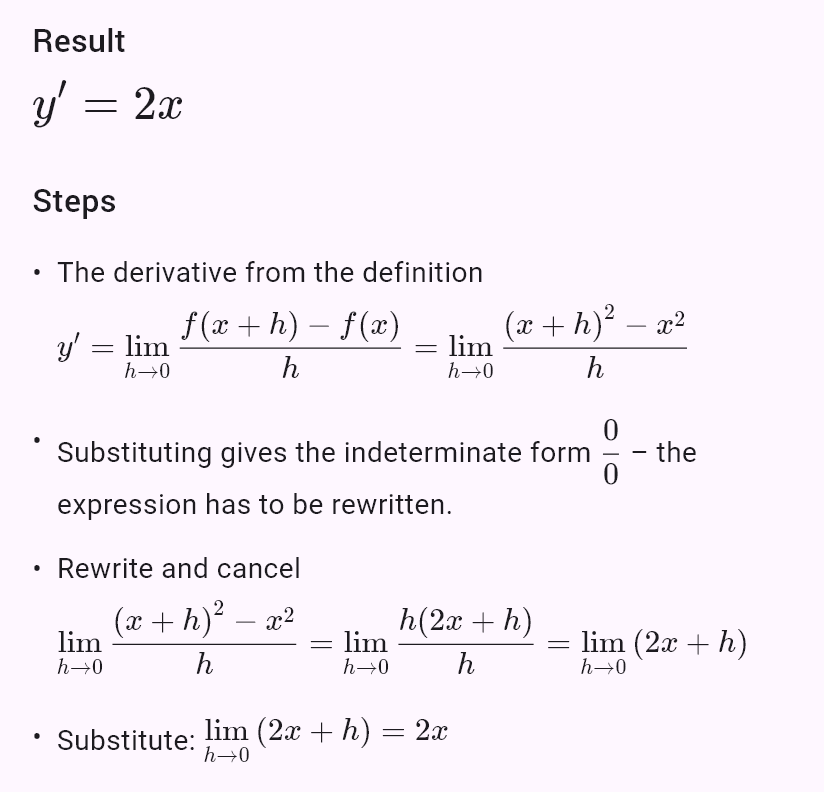
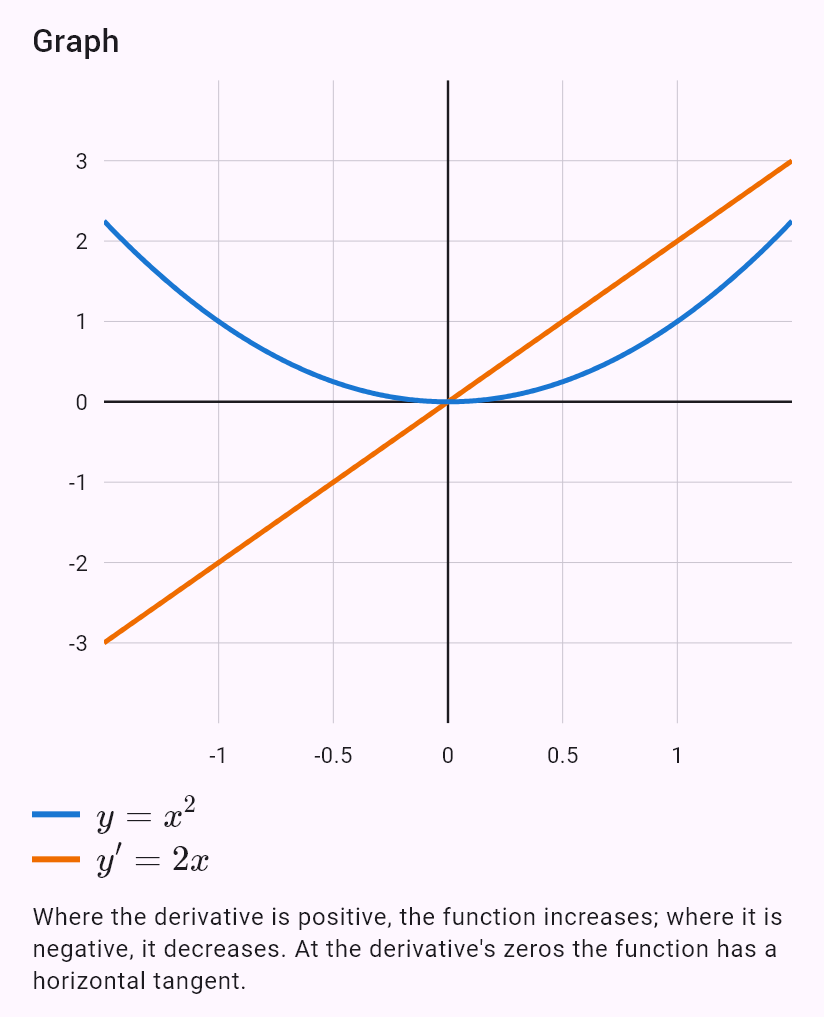
The app differentiates by the rules – the sum, constant multiple, product, quotient and chain rules – and says at every step which rule it used. It also handles higher derivatives and the value of the derivative at a point. Basic functions (x², sin x, eˣ, …) can also be differentiated from the definition, as the limit of the difference quotient. The result comes with a graph of the function and its derivative.
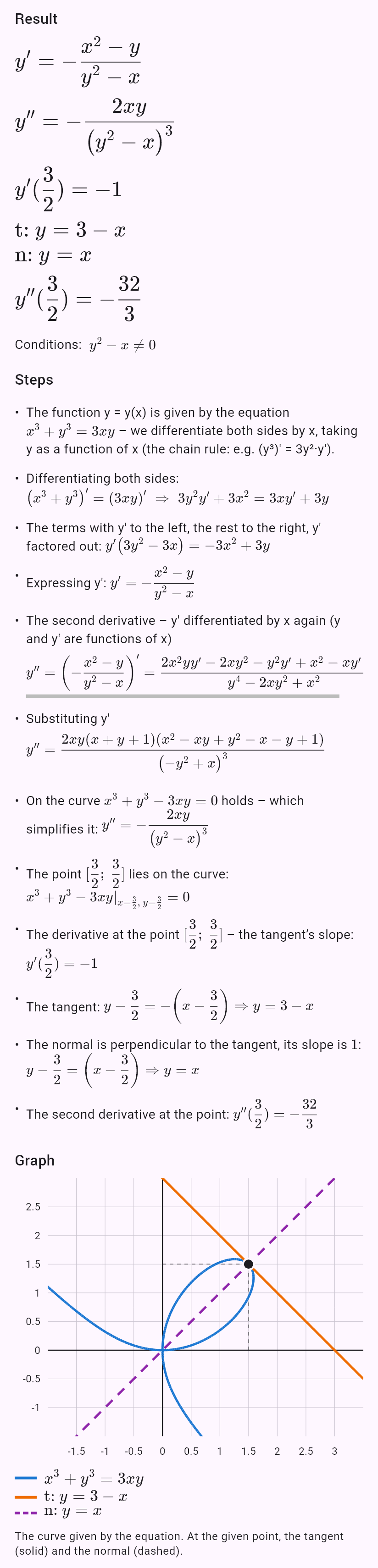
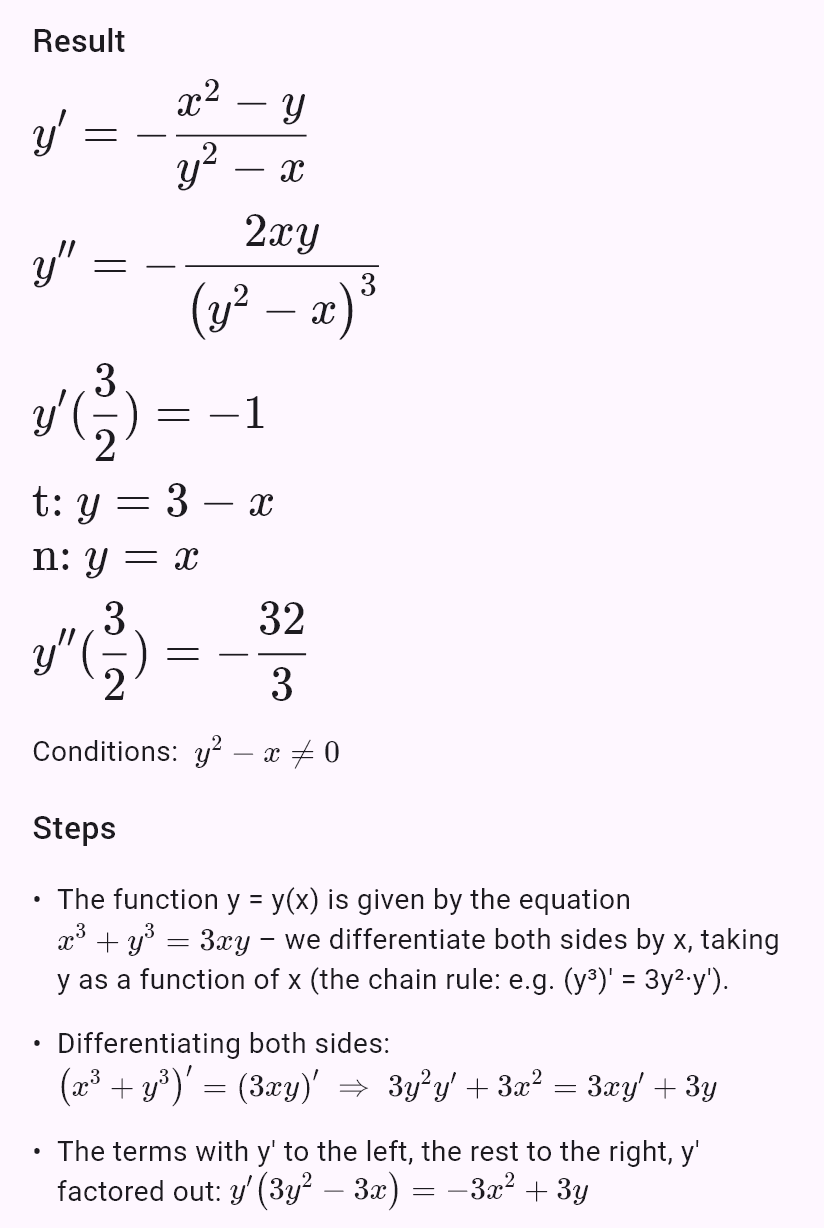
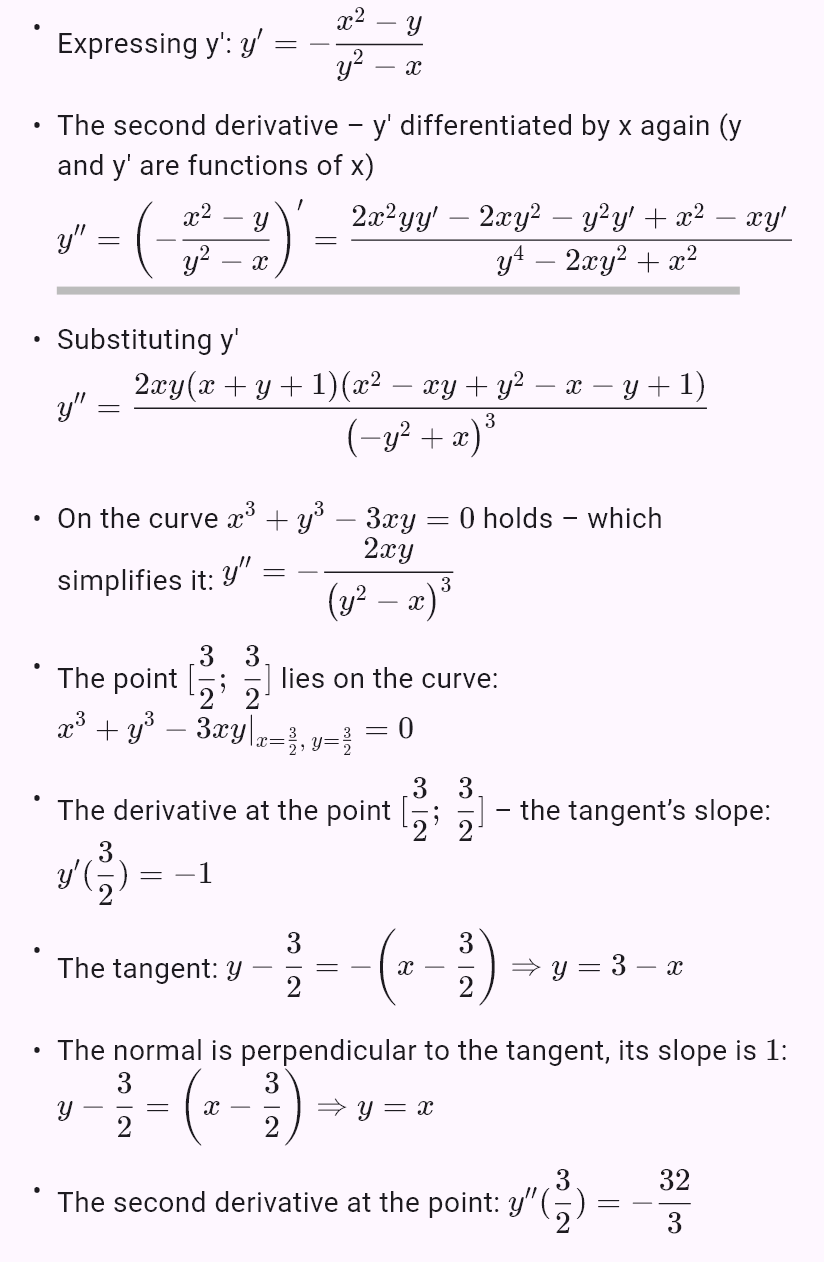
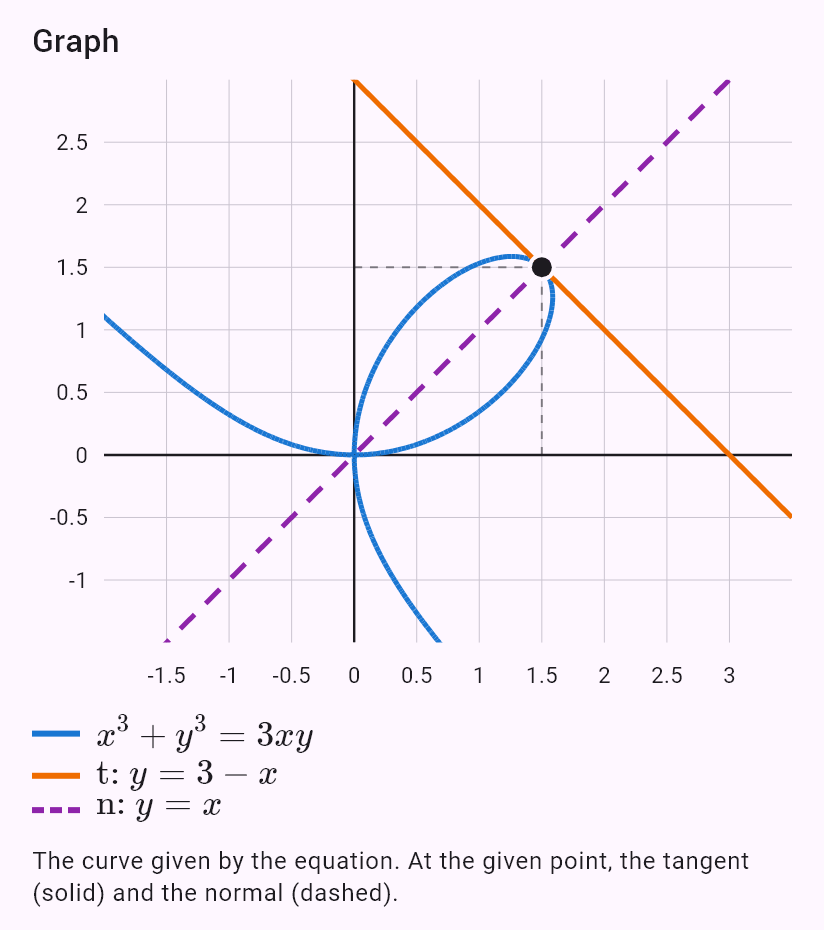
For a function given implicitly by an equation in x and y (x³ + y³ = 3xy) it differentiates both sides by x (y as a function of x) and expresses y′, or uses the formula y′ = −F_x / F_y; it also finds y″ and, at a given point, the tangent and the normal, and draws the curve.
At a singular point (the curve crosses itself or has a cusp) it finds the tangents from the equation’s lowest-degree terms – for the folium at the origin x = 0 and y = 0.
How to enter it
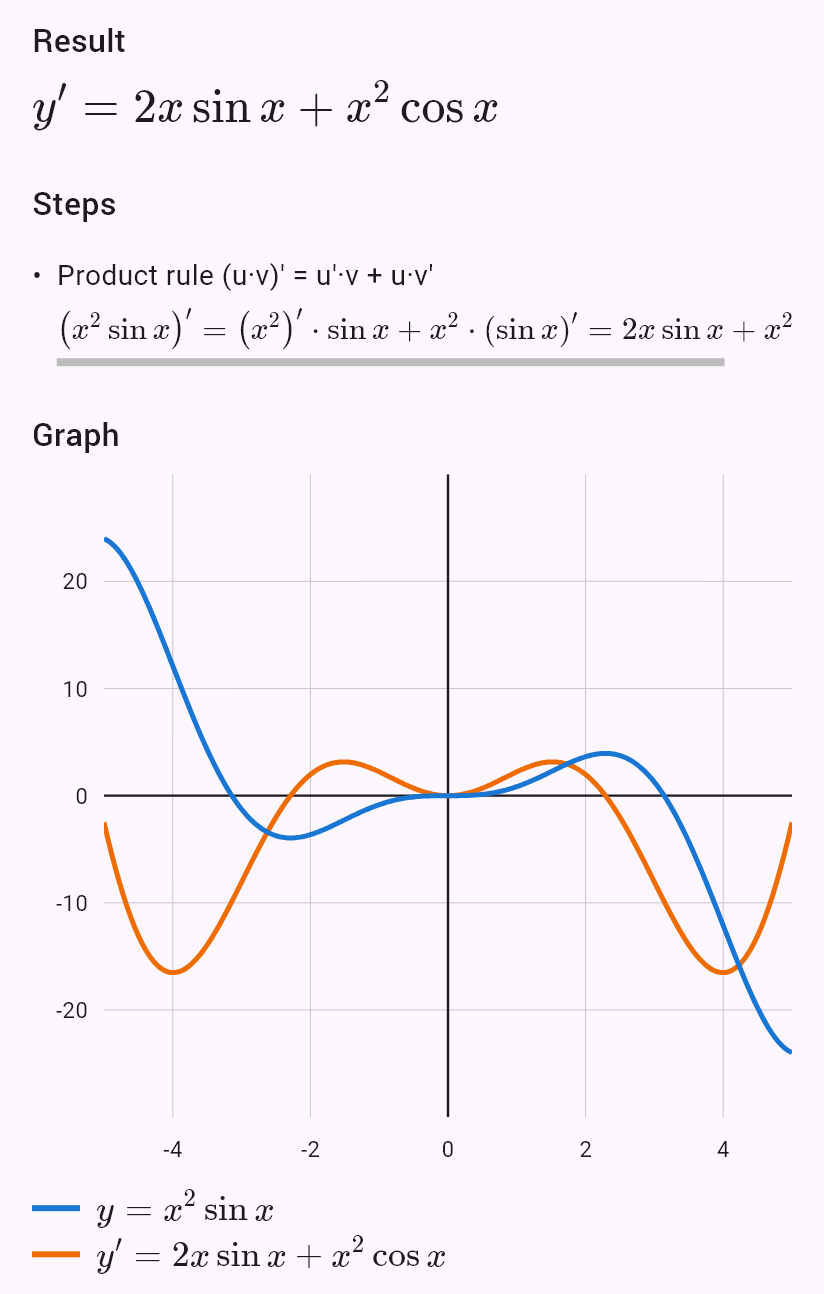
(x^2 sin x)' | A derivative with a prime after the bracket. |
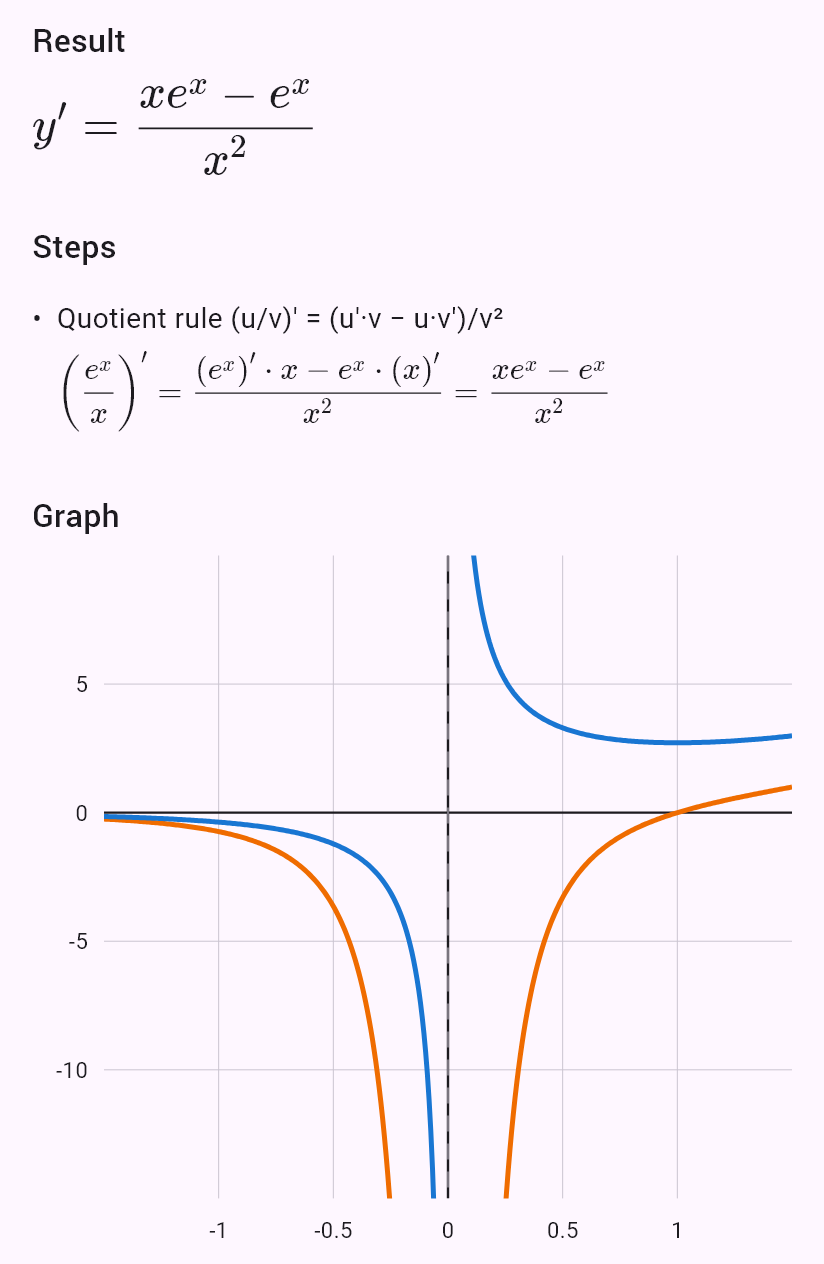
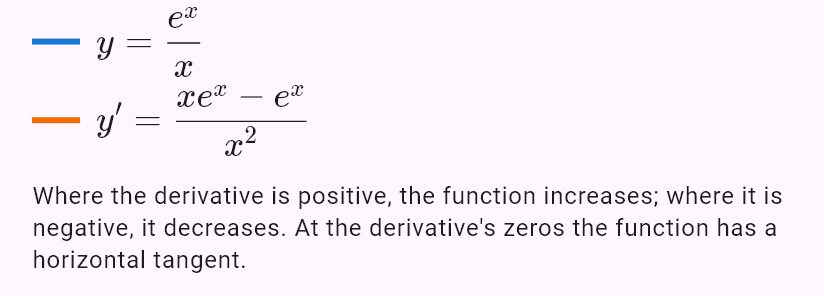
d/dx (e^x / x) | The d/dx notation, also from a photo (\frac{d}{dx}). |
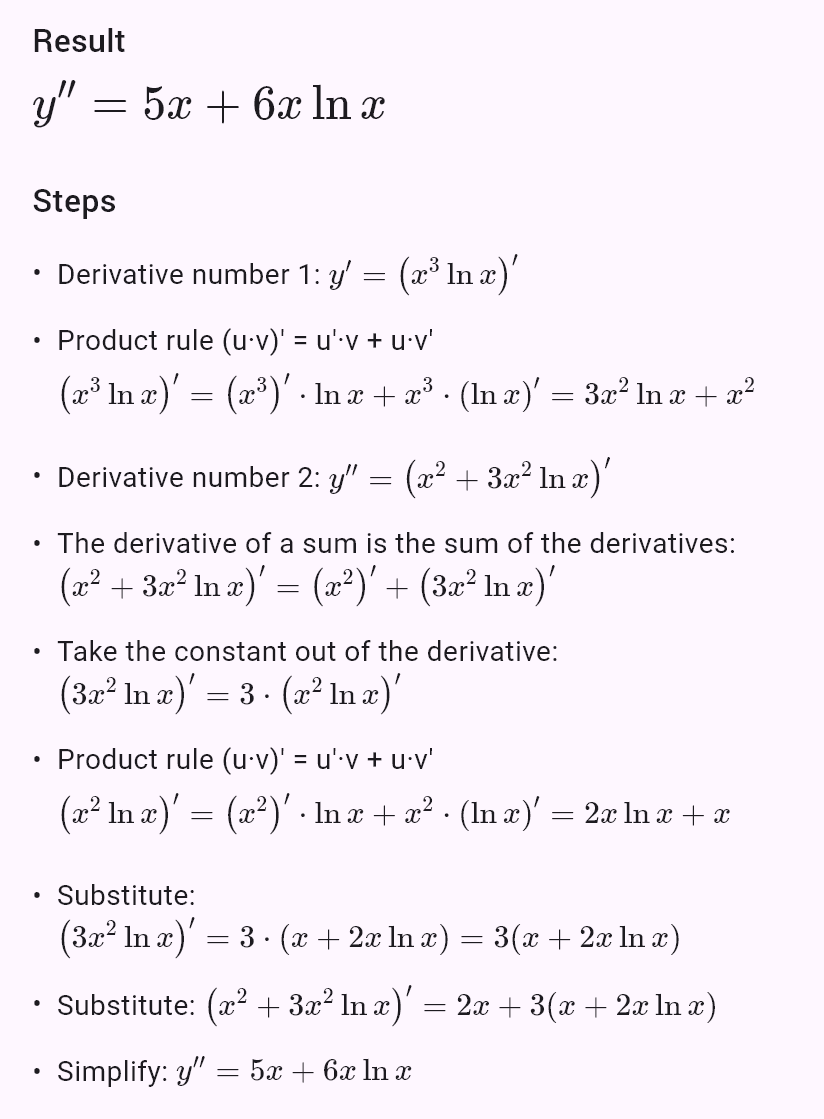
(x^3 ln x)'' | Higher derivatives with more primes, or with the order at the “Differentiate” chip. |
(x^2 + 1)'|_{x=2} | The derivative at a point, or fill in the point at the chip. |
x^2 sin x | An expression with the “Differentiate” chip – there you also choose the order, the point and the method (by the rules / from the definition). |
x^3 + y^3 = 3xy | An equation in x and y – the “Implicit derivative” chip (order 1 or 2, the method, a point [x₀; y₀]) or “Graph of the curve”; written diff(x^3+y^3=3xy, x). |
Examples
(x^2 sin x)'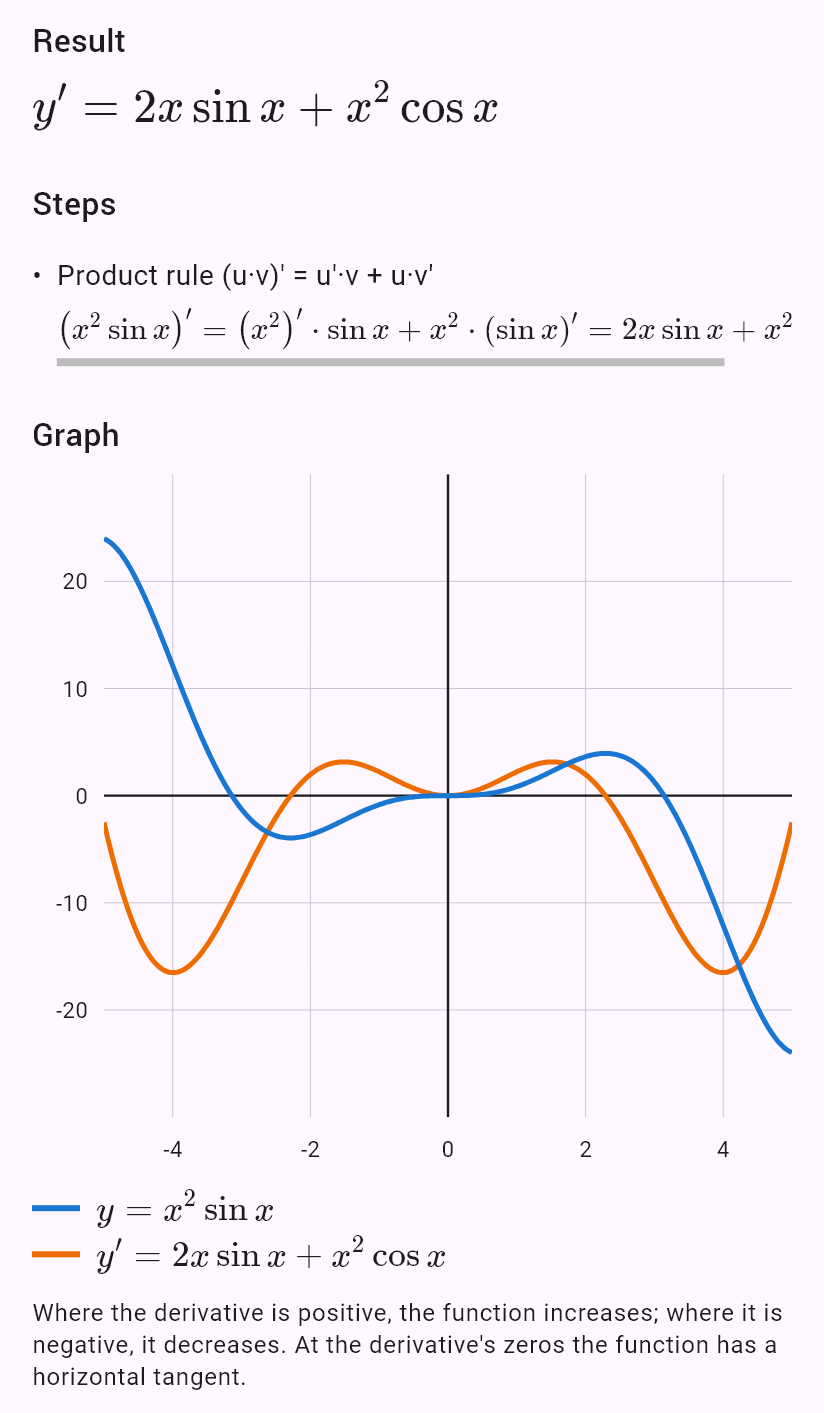

d/dx (e^x / x)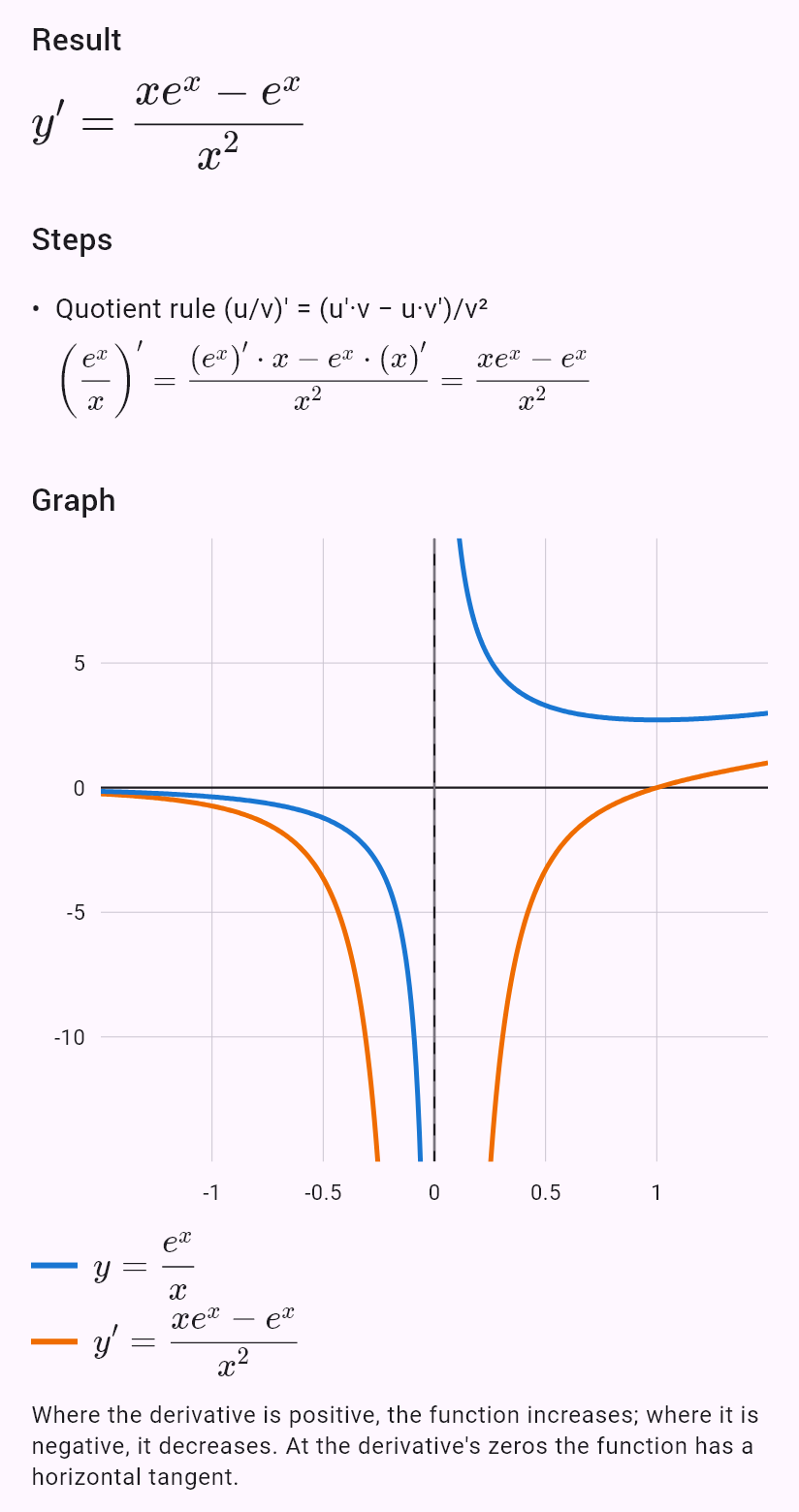
(x^3 ln x)''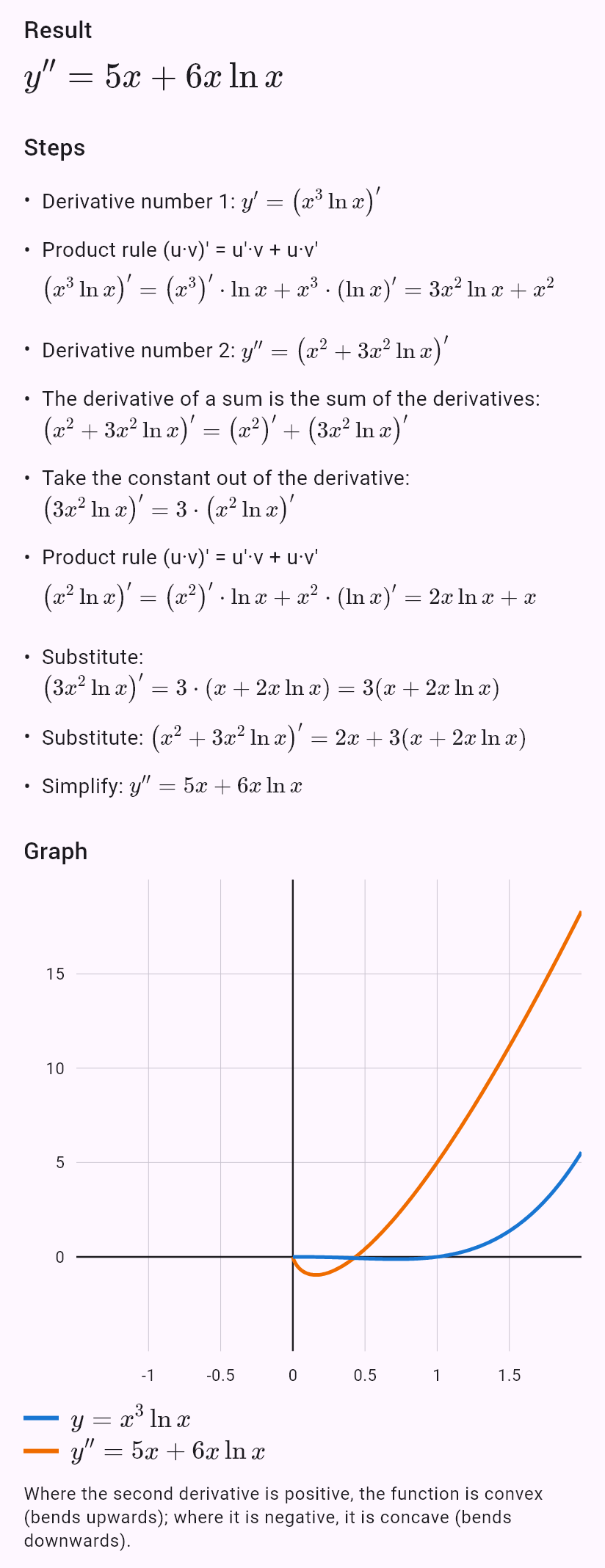
x^2 Differentiate → From the definition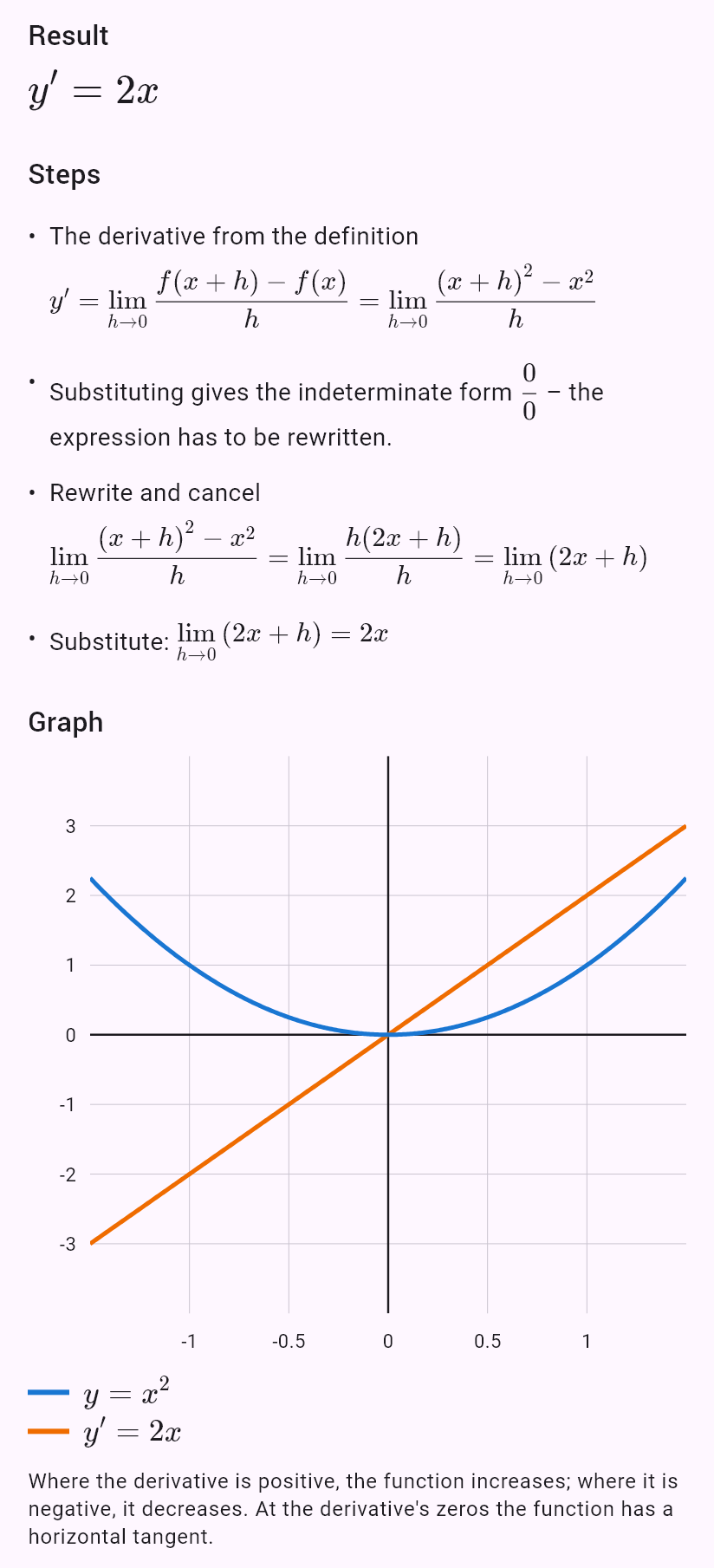
x^3 + y^3 = 3xy Implicit derivative, order 2, point [3/2; 3/2]