Infinite series
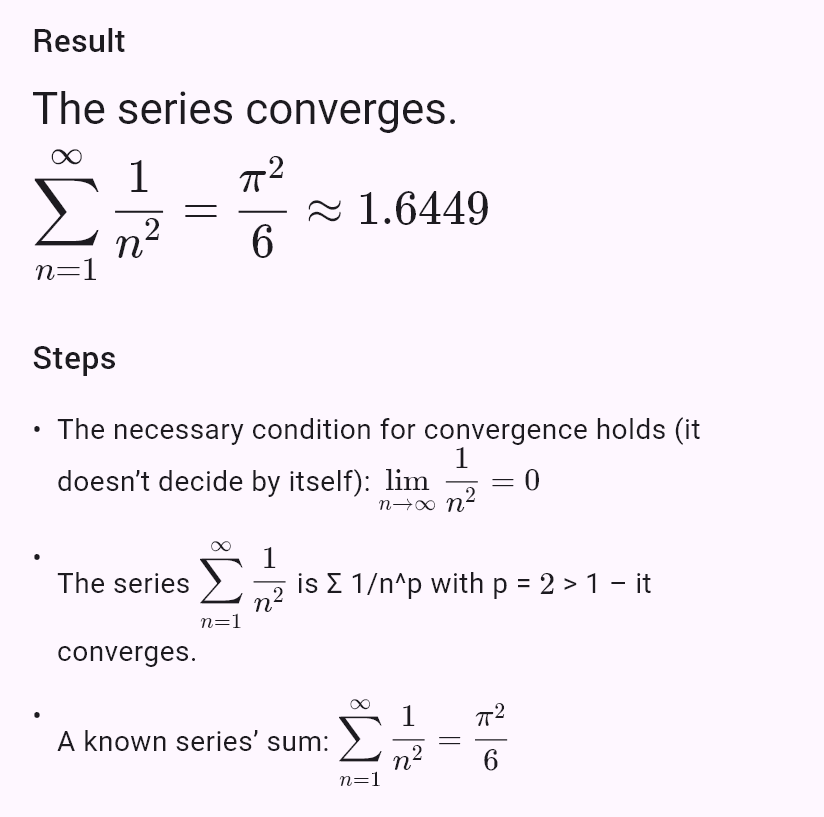
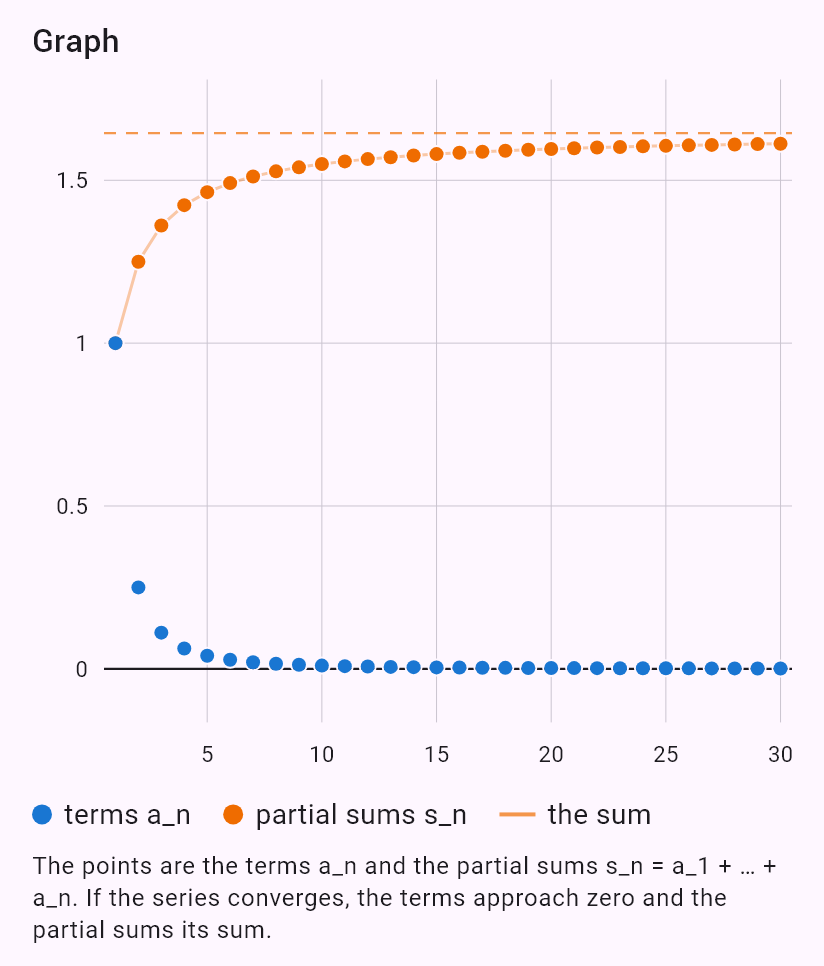
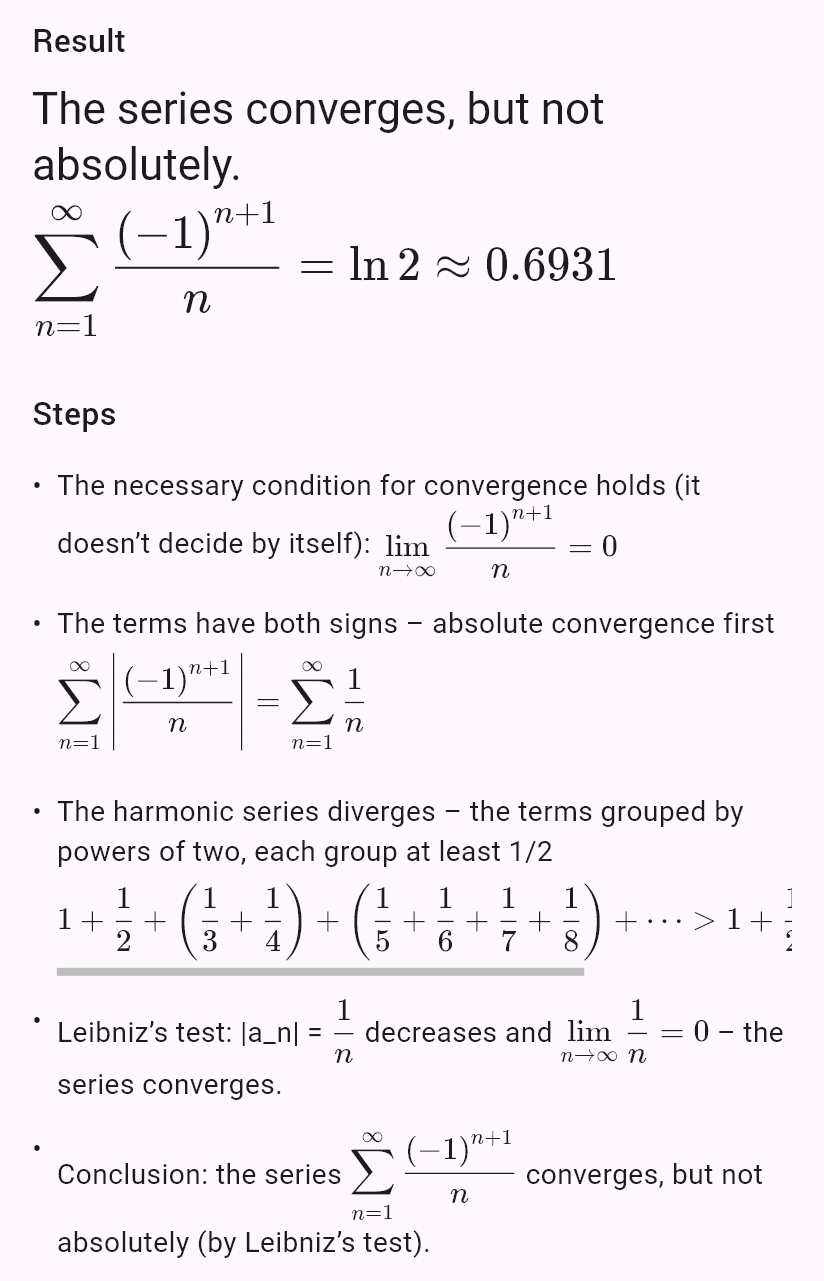
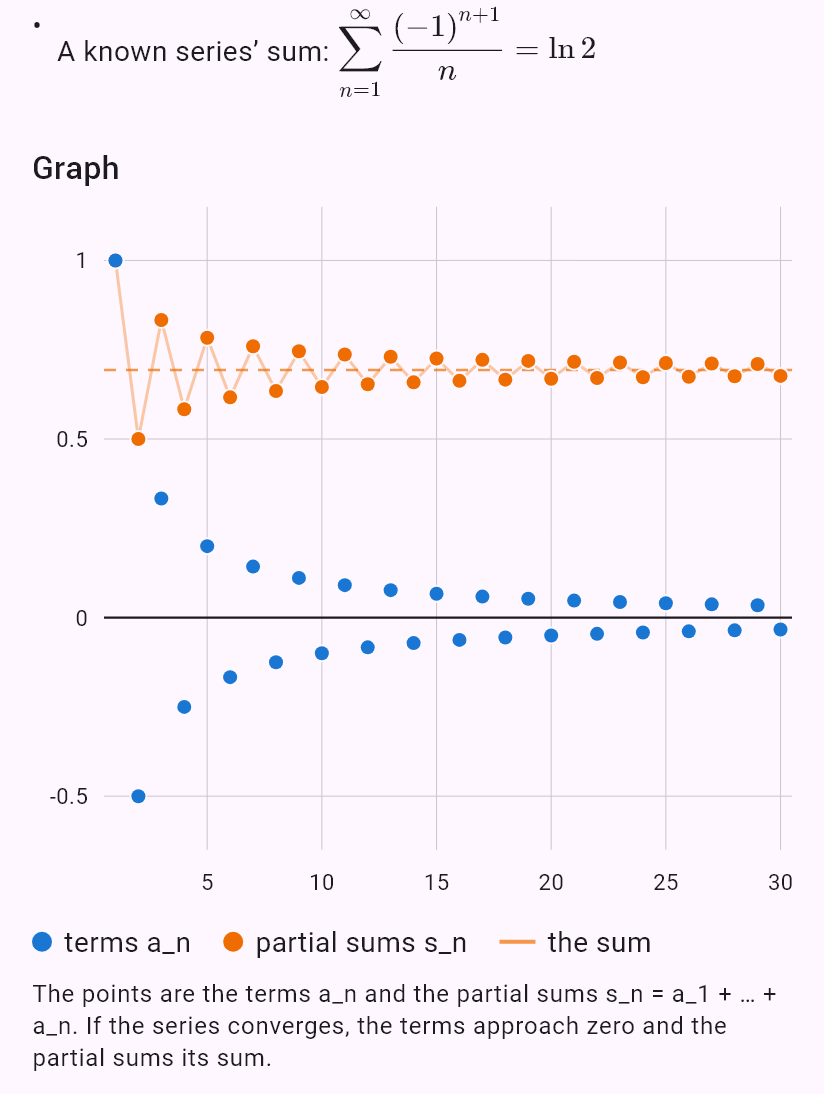
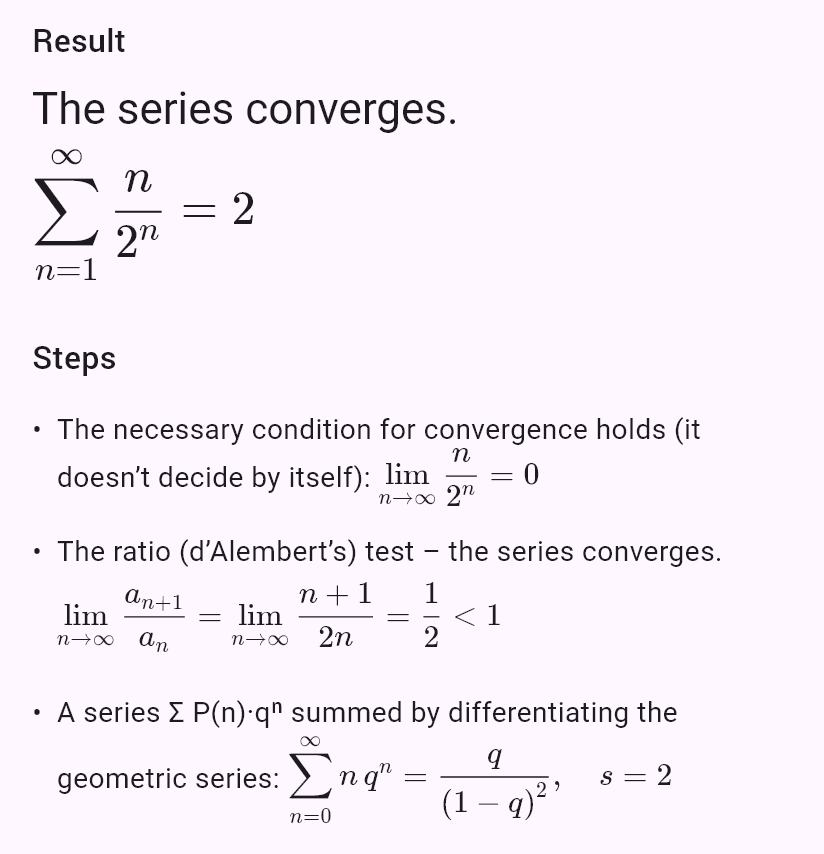
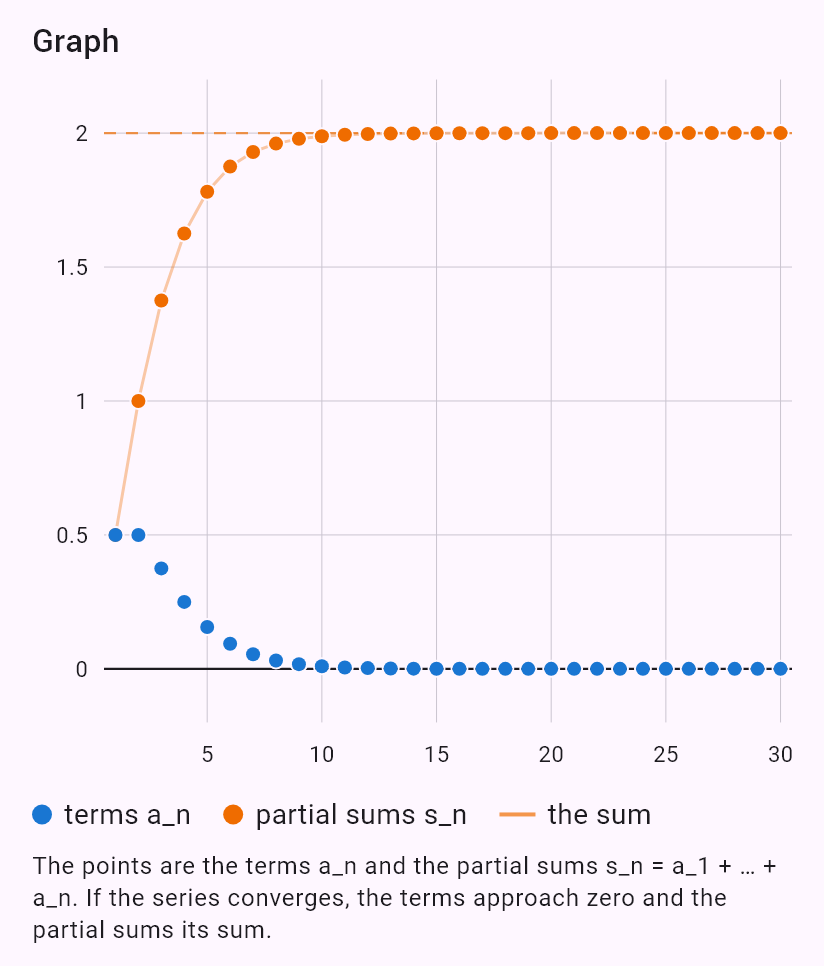
For a numerical series the app first checks the necessary condition for convergence (the term test) and then picks one test by the form of the series – geometric series, Σ 1/nᵖ, the ratio, root, limit comparison, integral or alternating series (Leibniz) test; for a series with alternating signs it distinguishes absolute and conditional convergence. Where possible it sums the series. The graph shows the terms and the partial sums.
Numerical series
The app finds the sum of geometric and telescoping series, series Σ P(n)qⁿ and well-known series (Σ 1/n² = π²/6); otherwise it computes it numerically. A finite sum is added up the school way – telescoping, arithmetic, geometric, otherwise term by term. An equation with the sum of a geometric series is solved too, with the condition of convergence |q| < 1 checked.
How to enter it
sum(1/n^2) | The general term; the index n from 1. |
sum(1/n^2, n, 1, oo) | With the index and the starting value. |
\sum_{n=1}^{\infty} \frac{1}{n^2} | From a photo or in LaTeX. |
1/n^2 | The general term with the “Series” chip – fill in the starting index in the field. |
sum(2k+1, k, 1, 100) | A finite sum – with the index, the lower and the upper bound. |
Examples
sum(1/n^2)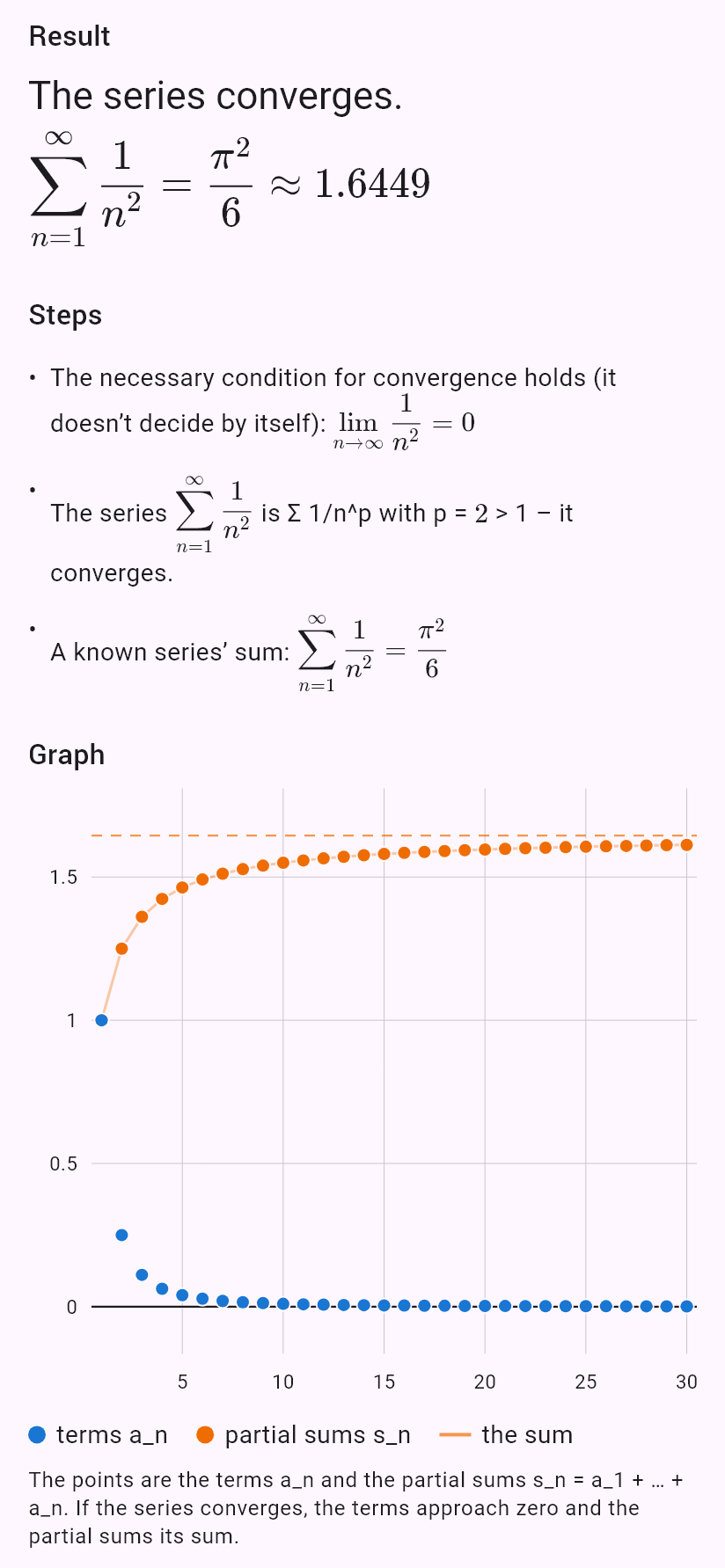
sum((-1)^(n+1)/n)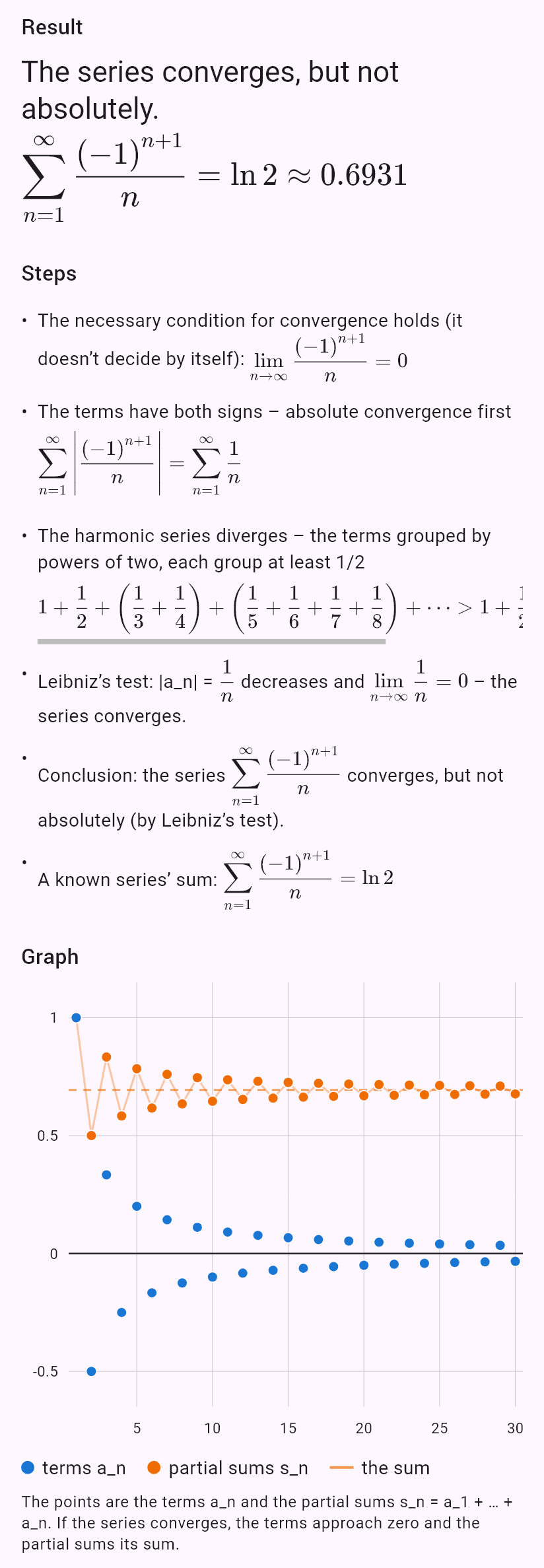
sum(n/2^n)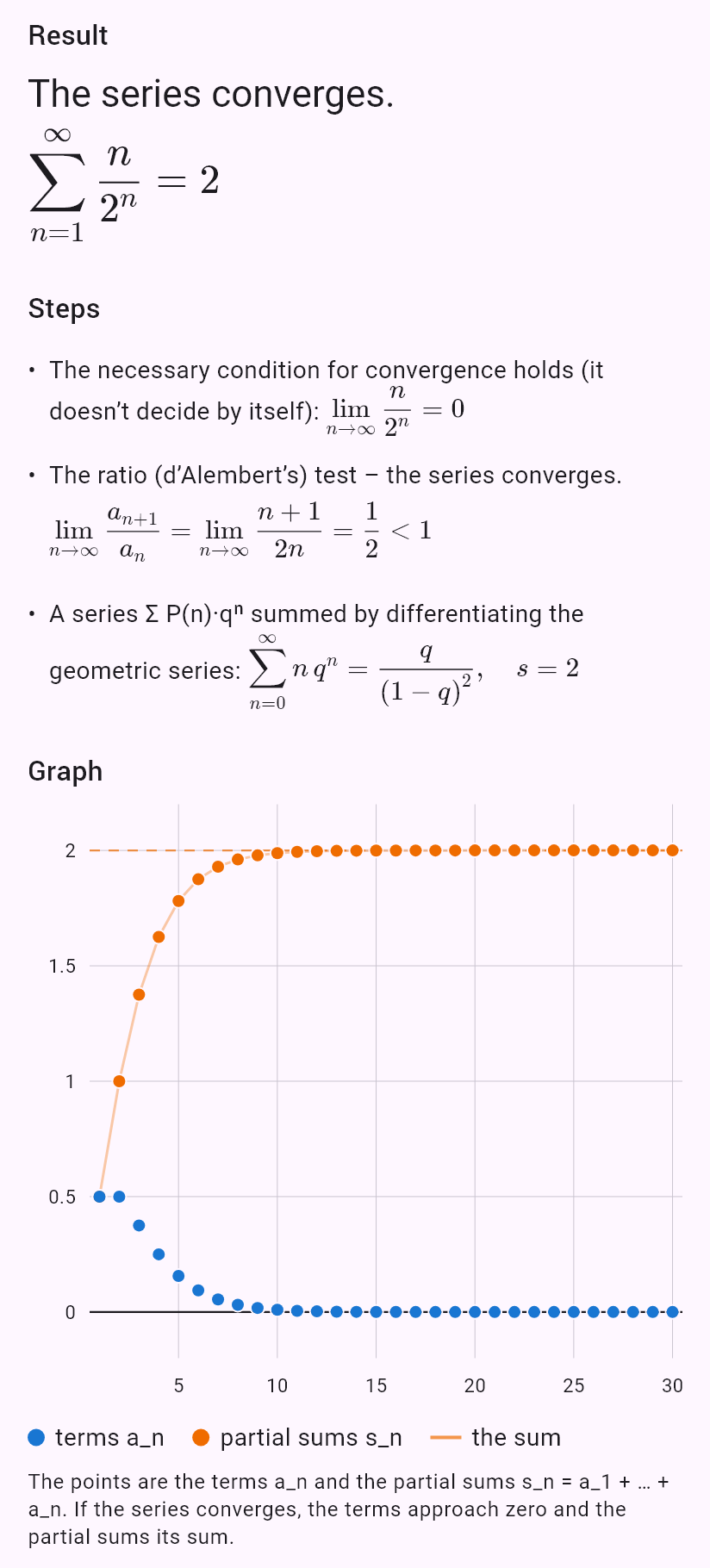
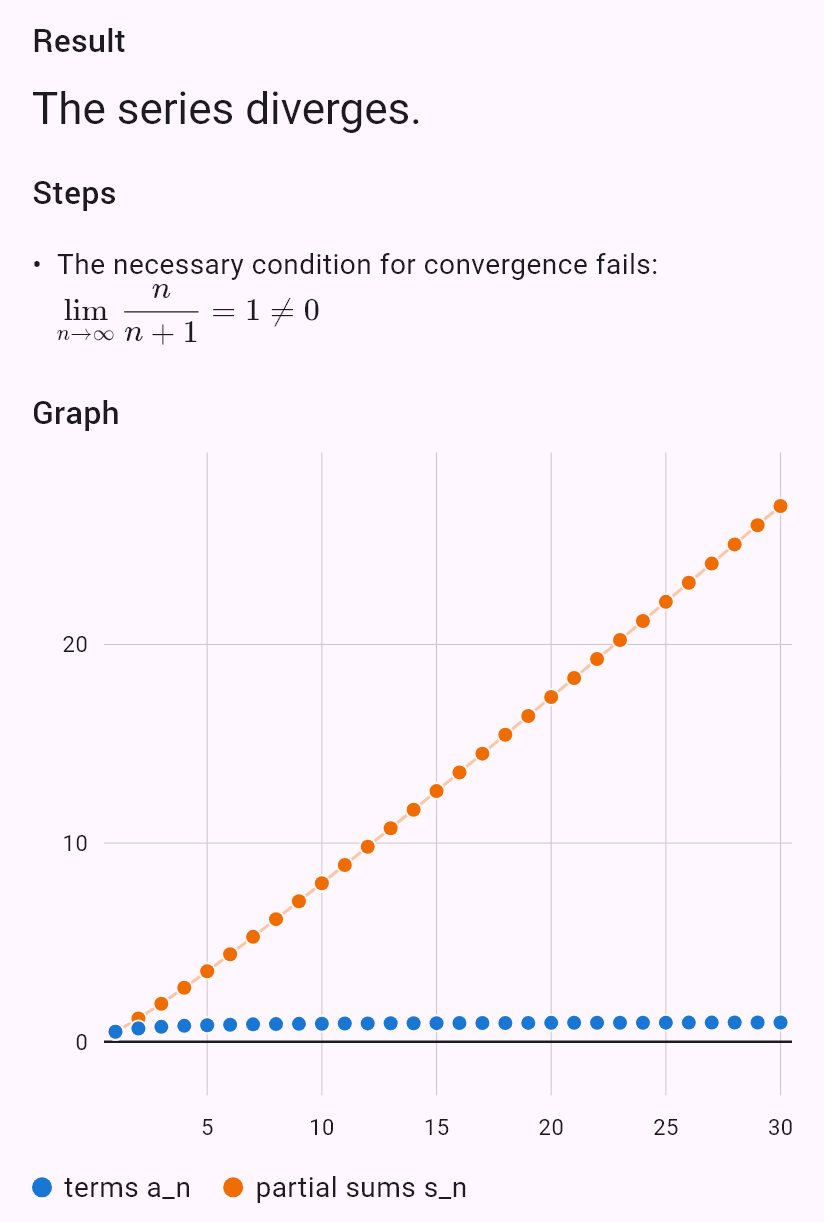
sum(n/(n+1))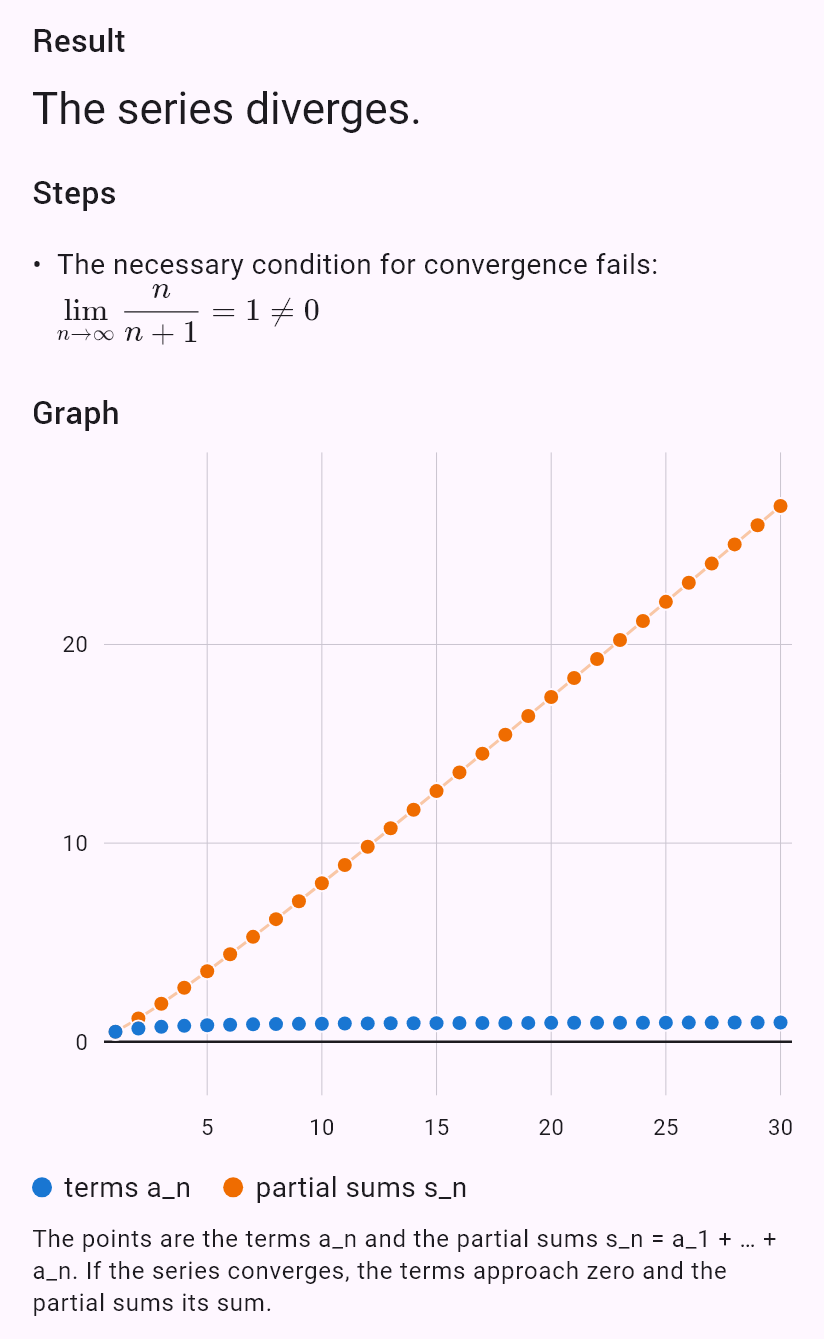

sum(sqrt(2i+1) - sqrt(2i-1), i, 1, 60)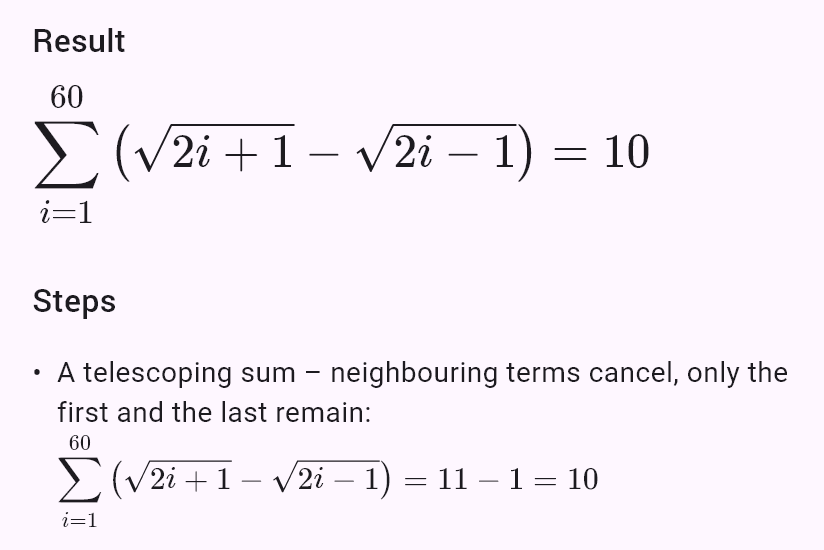
sum((2^x)^n, n, 1, oo) = 1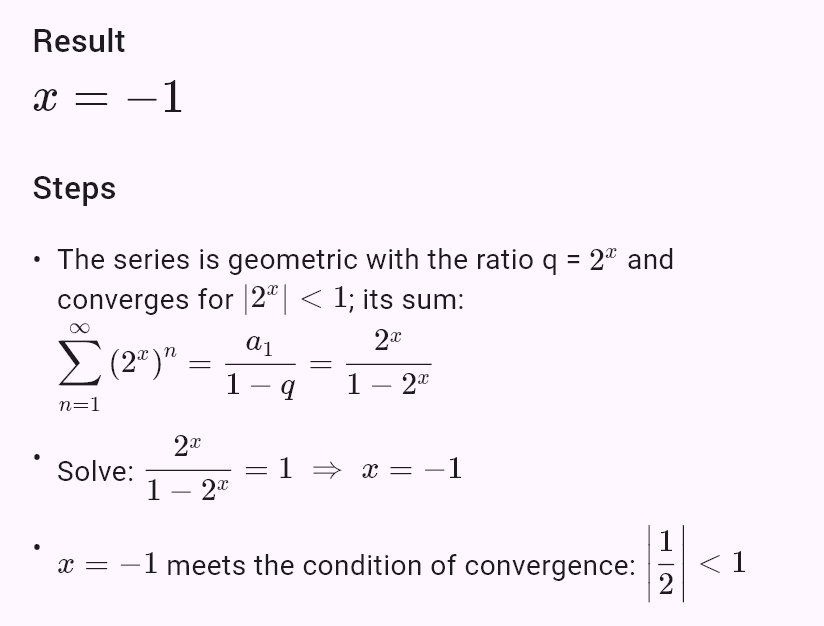
Power series
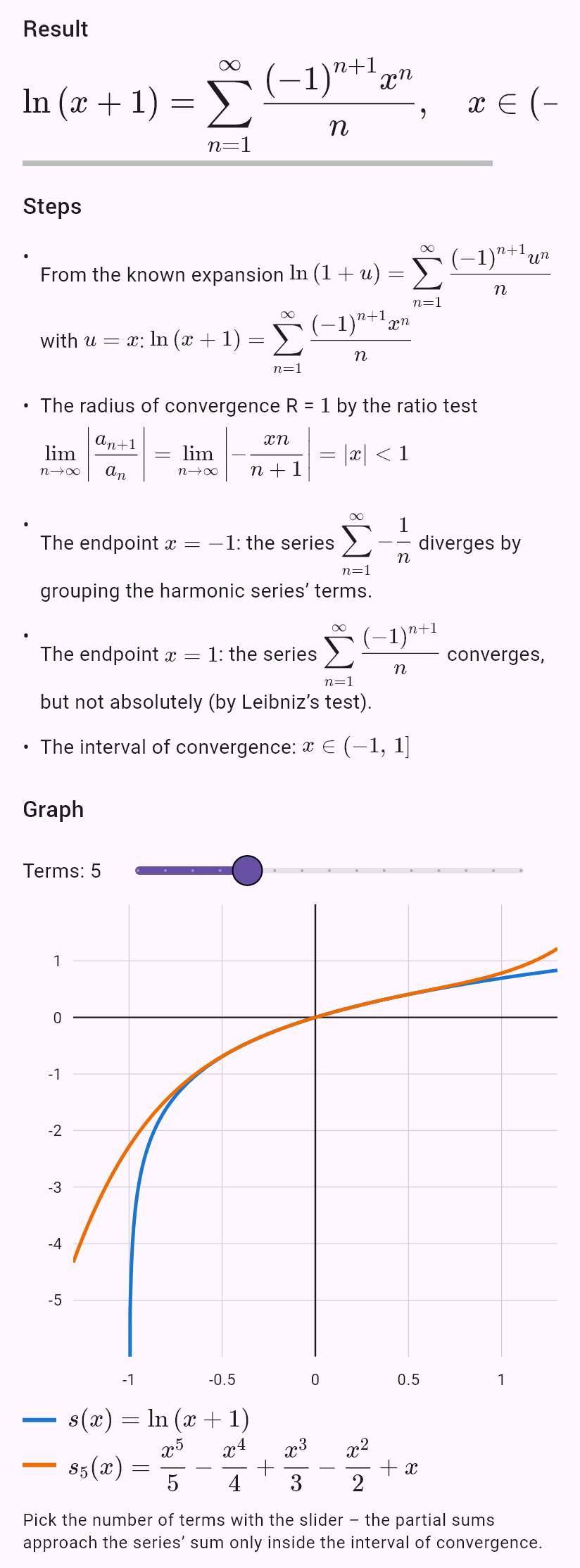
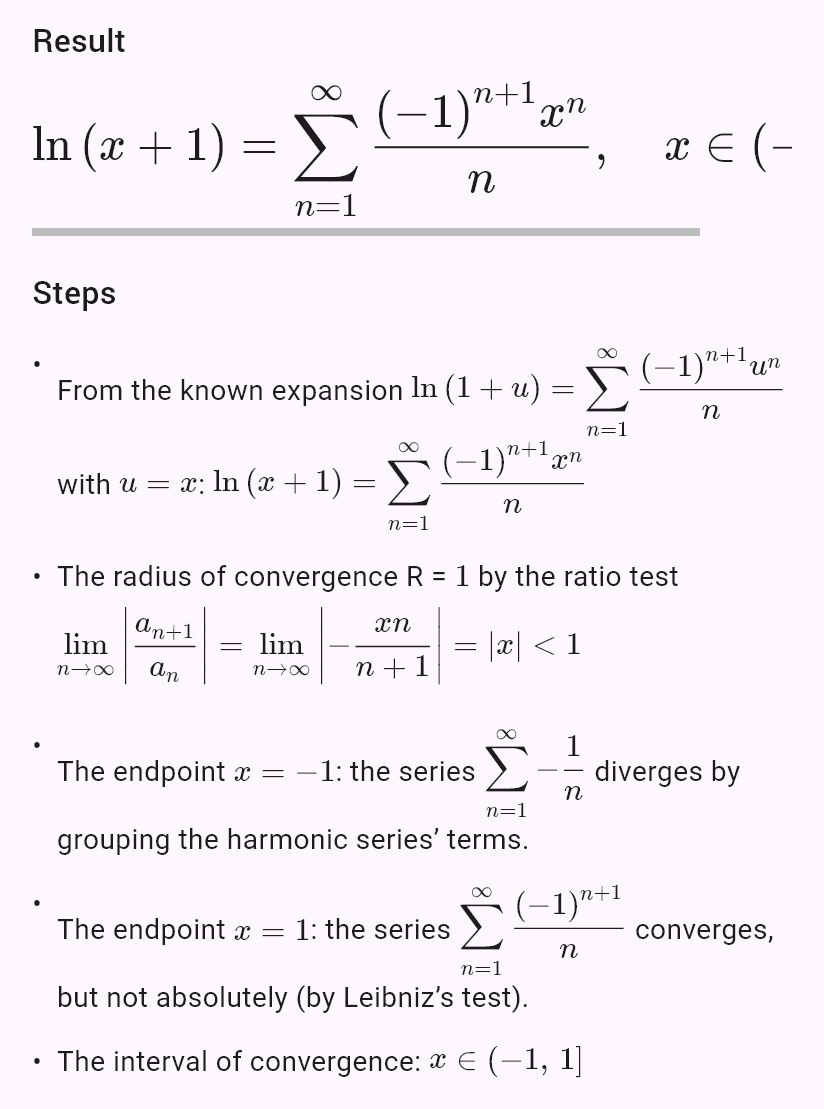
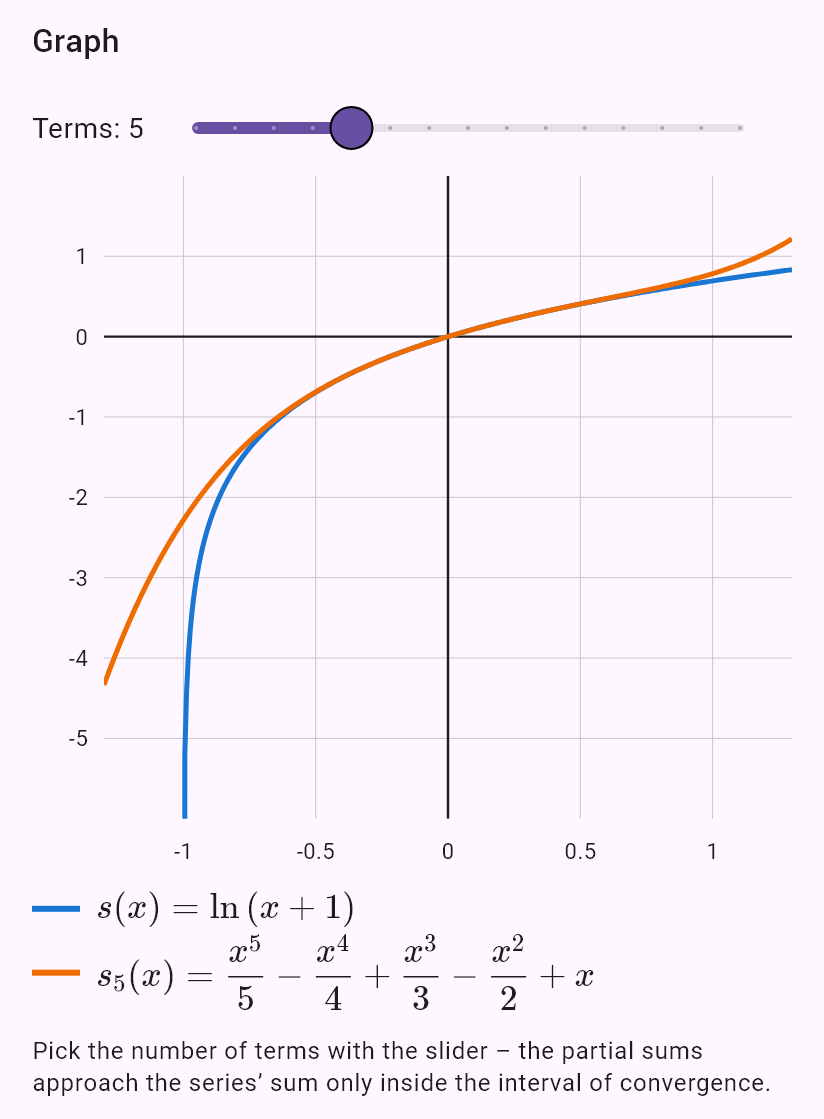
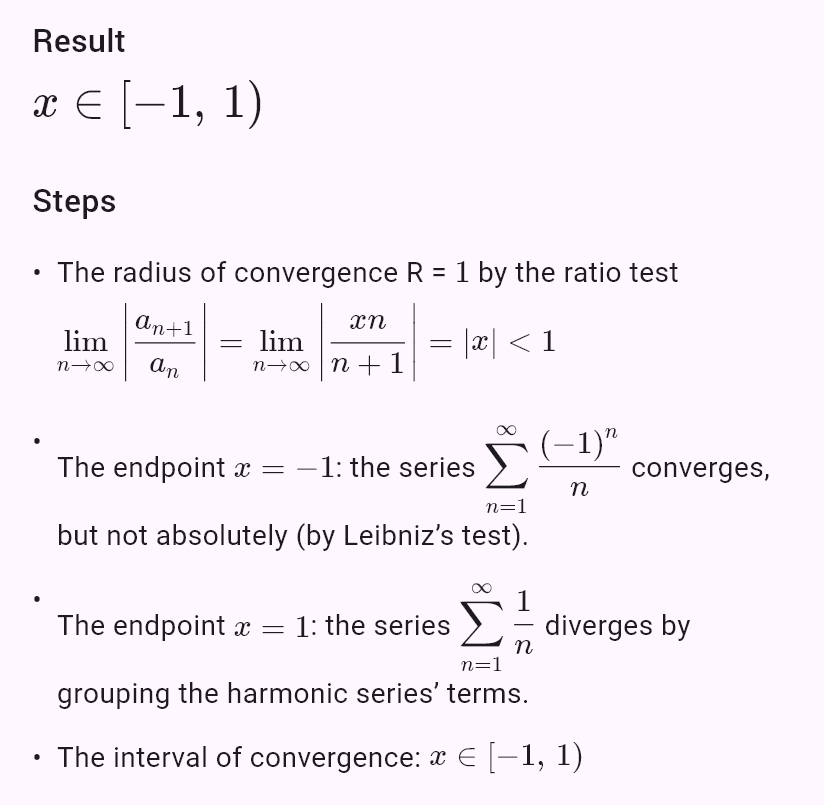
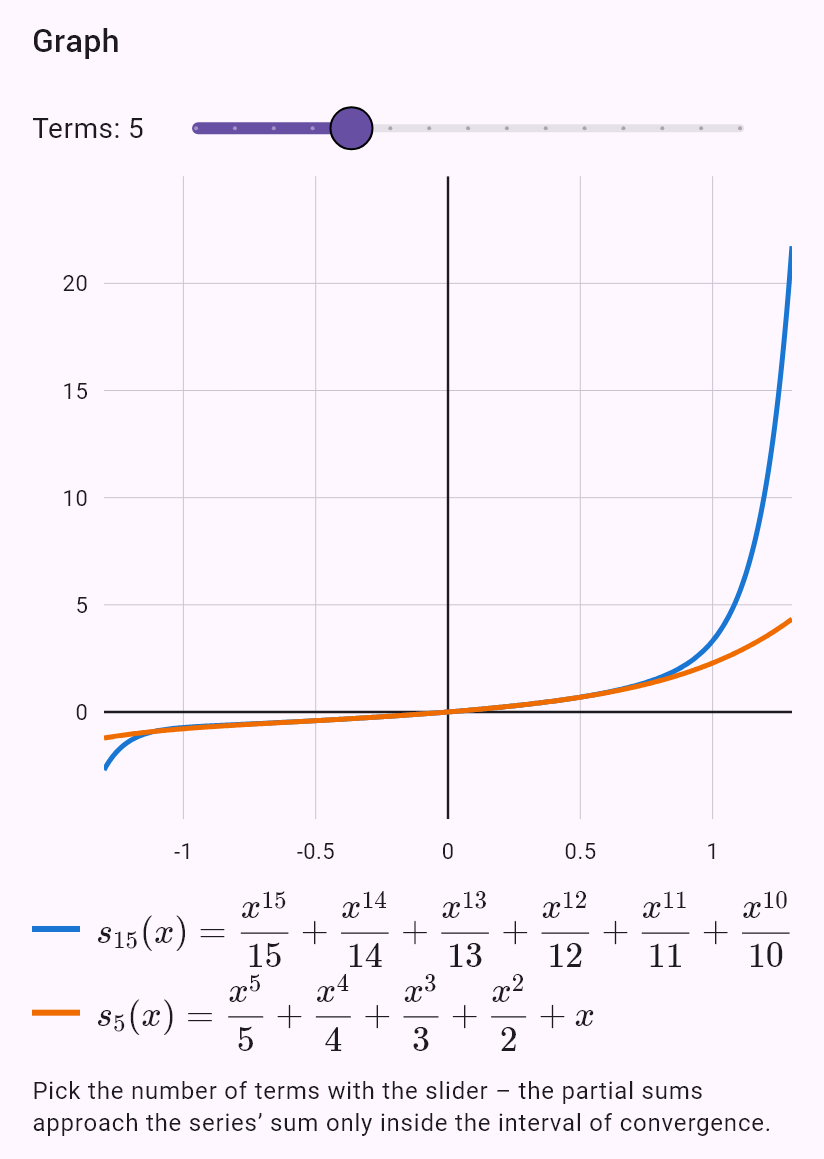
For a power series the app finds the radius of convergence by the ratio test, examines the endpoints as numerical series and states the interval of convergence; where possible also the sum. The graph shows the partial sums with a slider for the number of terms.
Examples
sum(x^n/n)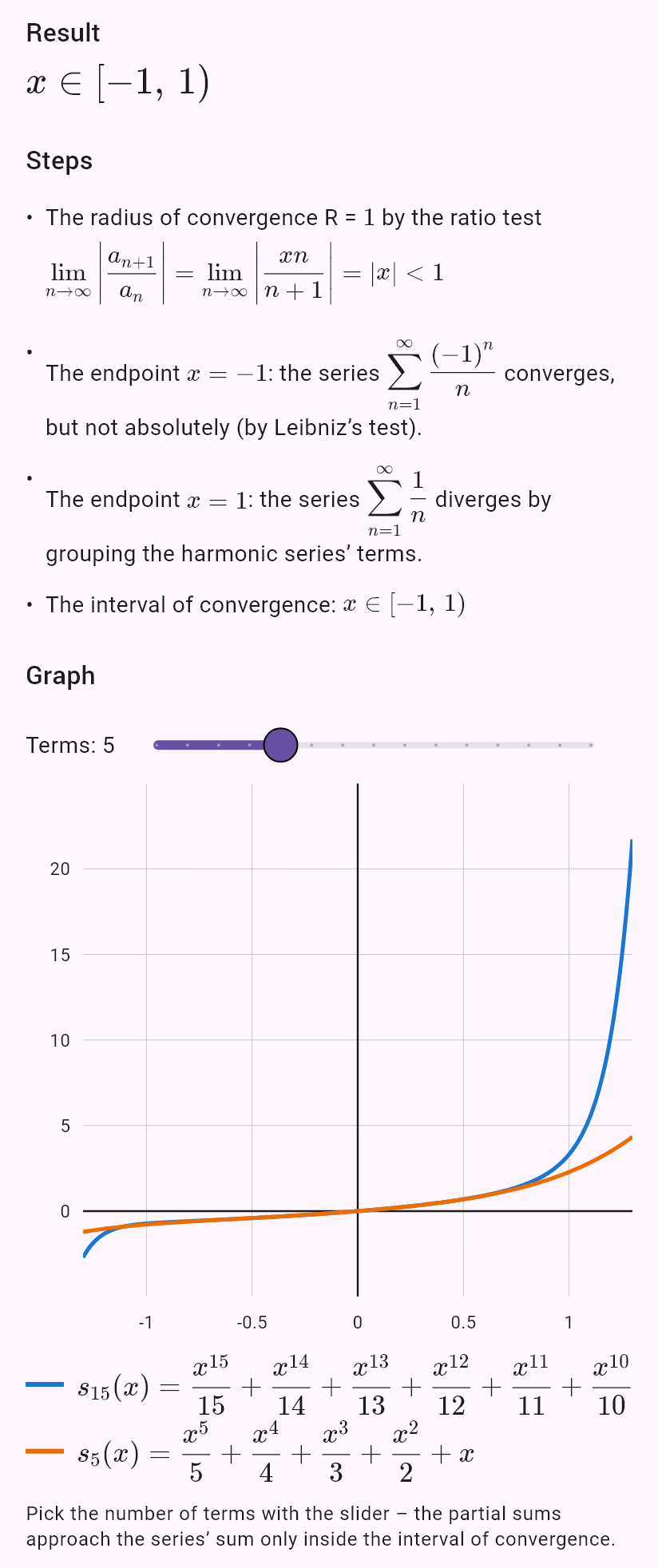
Taylor series
The app derives the Taylor series of a function from known expansions (eˣ, sin x, ln(1 + x), …) by substitution and determines its interval of convergence.
How to enter it
taylor(e^x, 0, oo) | The function, the point and oo instead of the degree; or the “Taylor polynomial” chip → “Series”. |
Examples
taylor(ln(1 + x), 0, oo)