Equations and inequalities with a parameter
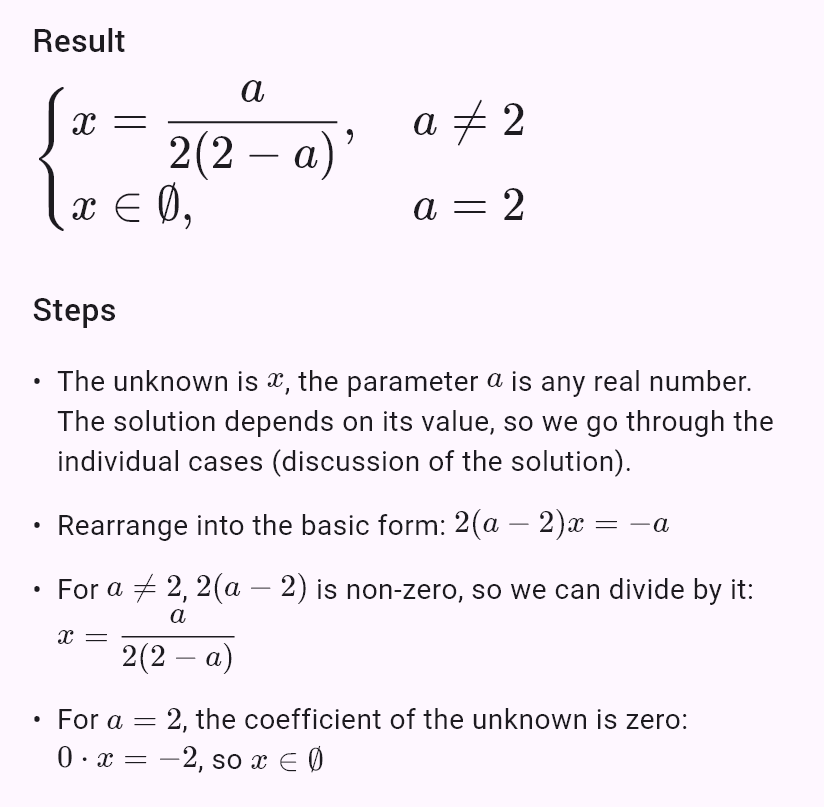
A letter in an equation besides the unknown is a parameter – any real number the solution depends on. The app rearranges the equation into the form A·x = B (a quadratic one into A·x² + B·x + C = 0) and discusses the solution by the parameter's values: where the coefficient of the unknown is zero, where the discriminant is positive, zero or negative, where the conditions exclude a root and for which values the problem makes no sense. The result sums up the cases.
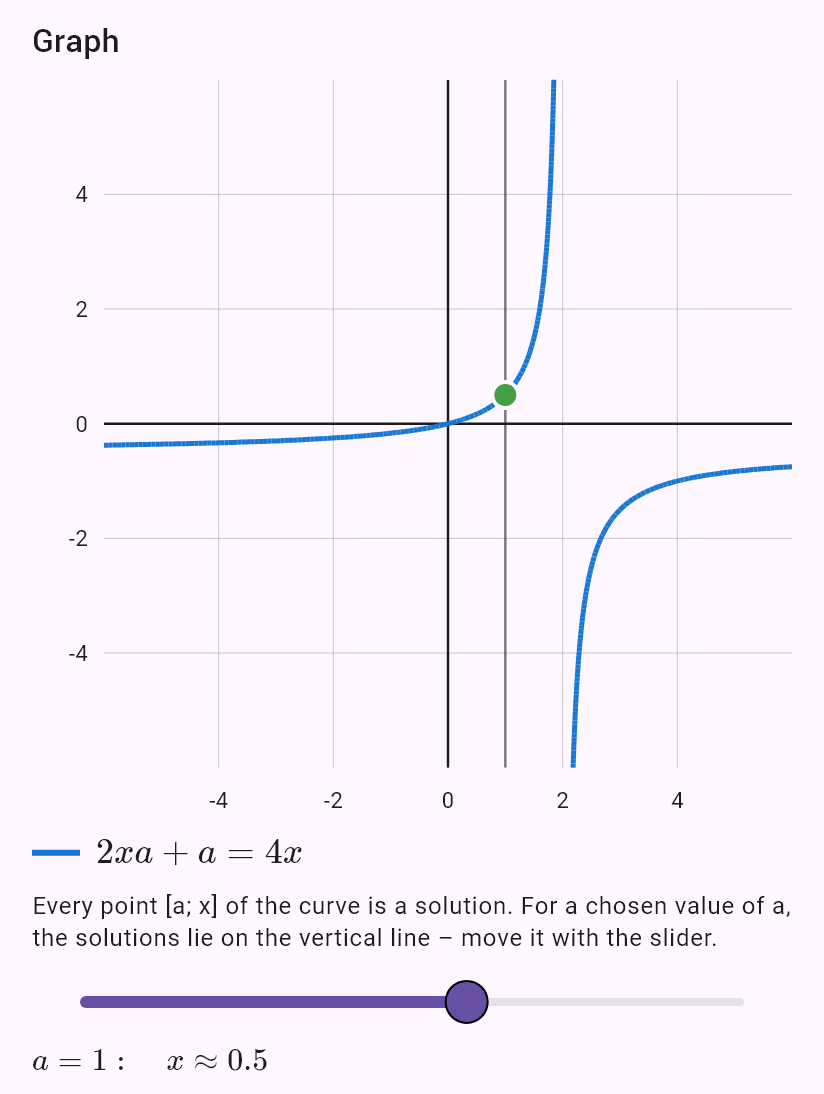
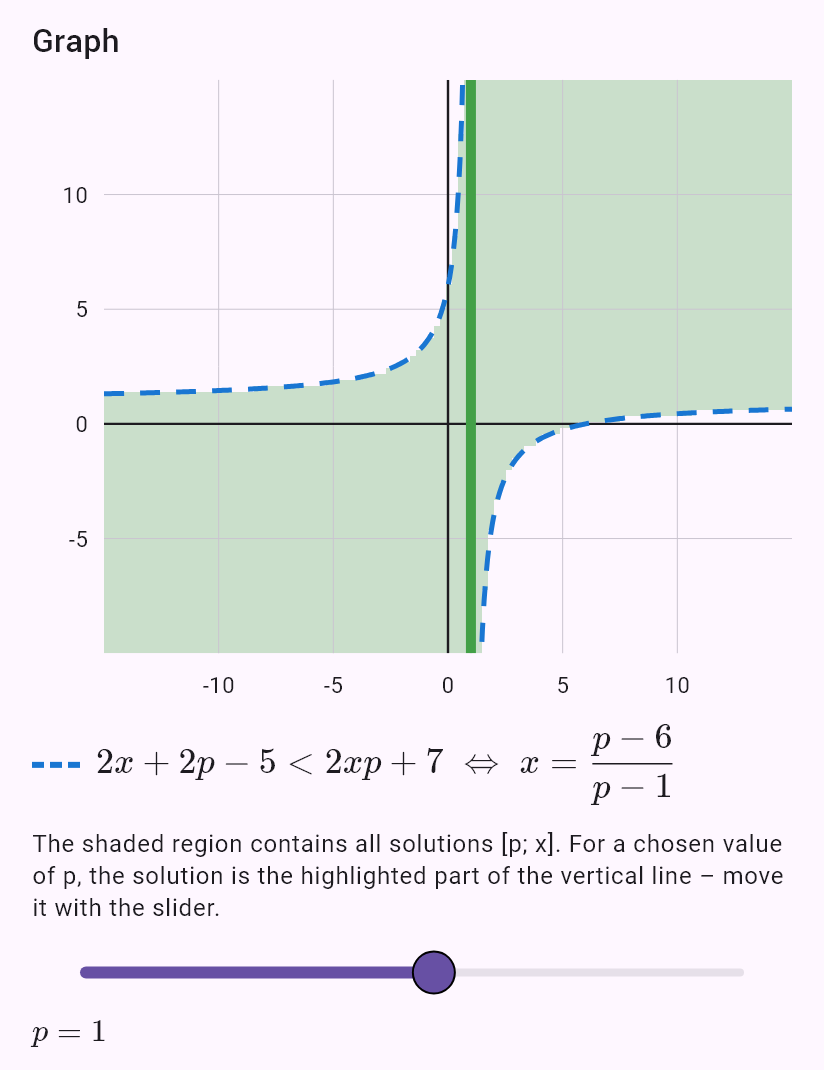
The app takes the unknown in the order x, y, z, u, v, w, t; the other letters are parameters. Choose another unknown with the “Unknown” chip or write it after a comma. The graph shows all solutions as a curve (a region for an inequality) in the parameter–unknown plane; pick the parameter's value with the slider and read the solutions off the vertical line.
After a comma you can also ask about the roots: “x^2 + px + 4 = 0, x > 0” – for which p every root is positive (the chip “The condition holds for” switches to at least one root), “…, x = 3” – for which p 3 is a root. A linear equation’s root is put in the condition, a quadratic one’s by Vieta’s formulas. A system of two linear equations with a parameter is solved by determinants (Cramer’s rule), with the cases of one, no and infinitely many solutions. A quadratic or a rational inequality is discussed by the order of its zeros. The graph’s slider stops exactly at the parameter’s critical values, which are also listed under the graph.
In an indefinite integral, other letters are constants – the app adds which must not be zero (∫ dx/(a − bx)³ for b ≠ 0).
How to enter it
2ax + a = 4x | Every other letter is a parameter; the unknown is x (or y, z, …). |
(q+3)x = 2x + q, unknown q | You can name the unknown or the parameter after a comma (“a is a parameter”, “unknown q”). |
x^2 + px + 4 = 0, x > 0 | A question about the roots after a comma: for which p every root (or at least one) has the property. |
Examples
2ax + a = 4x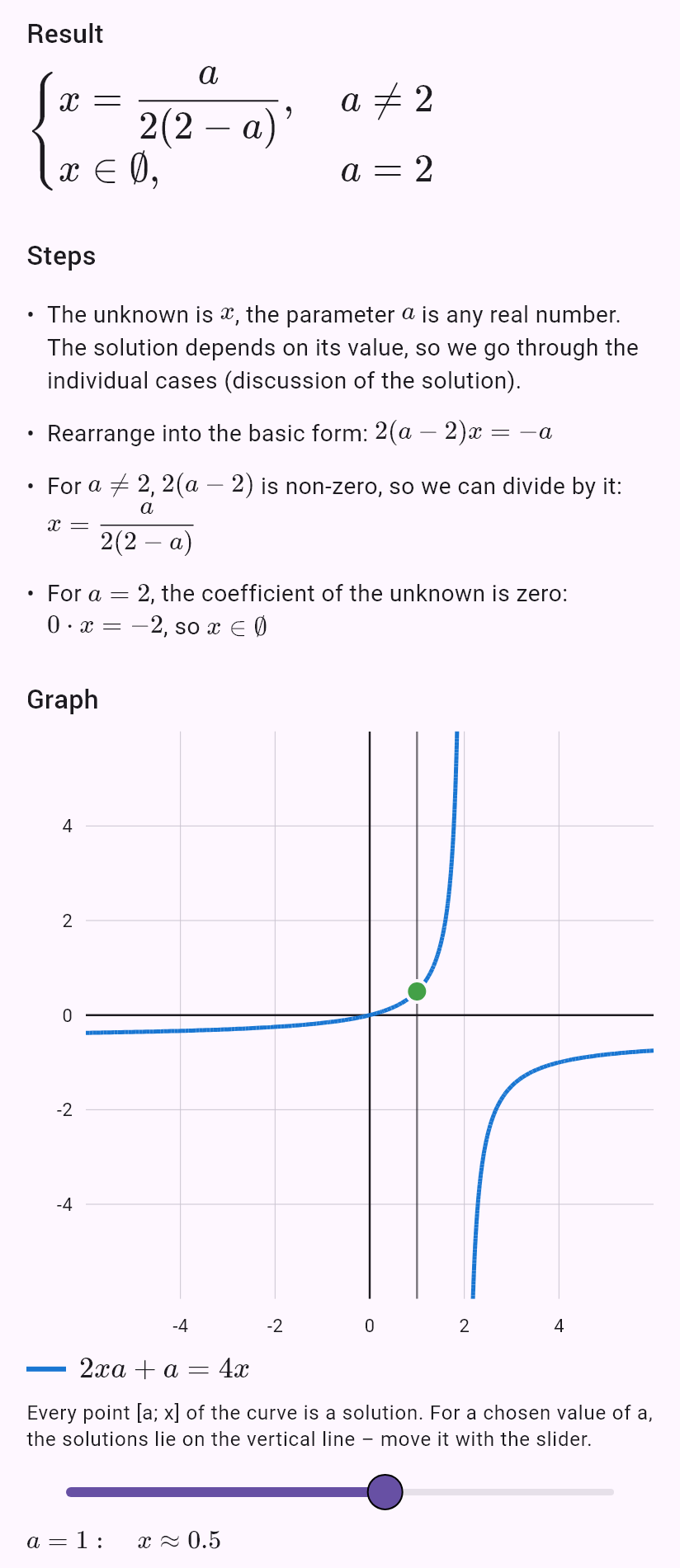
x^2 + 6x + p = 0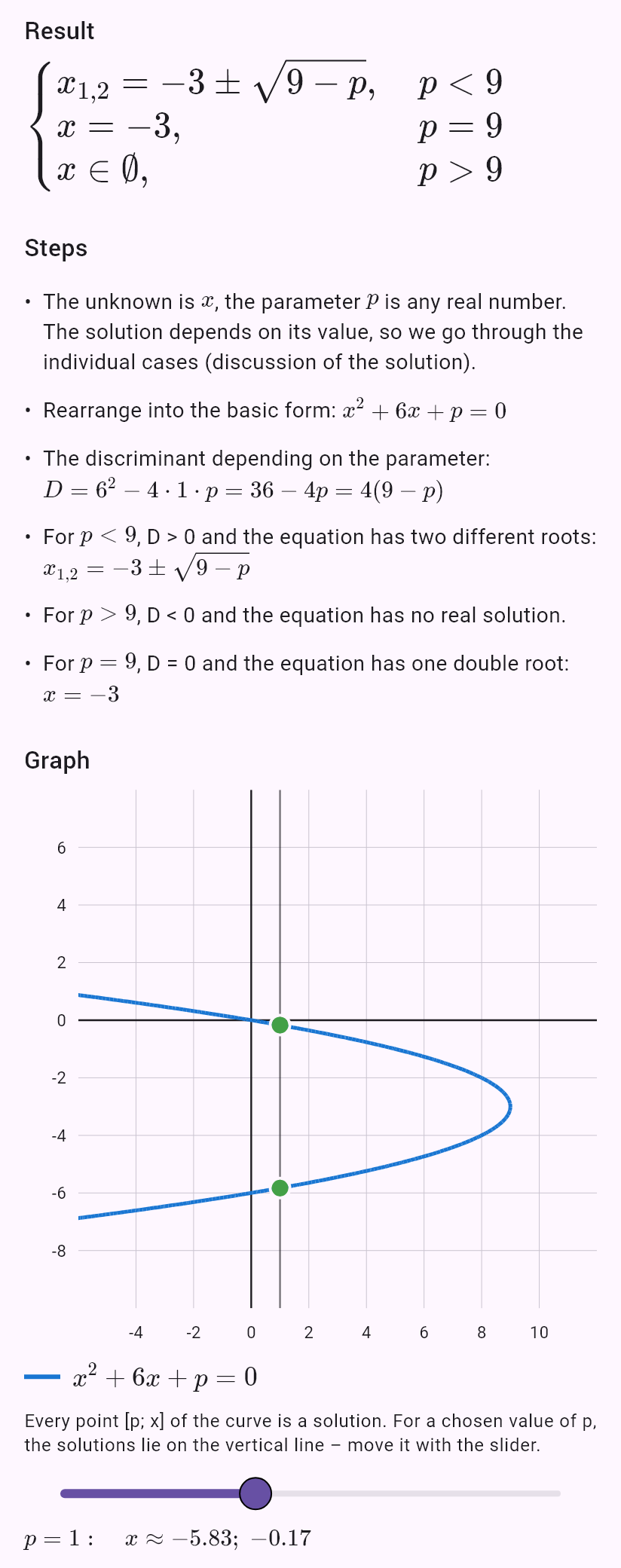
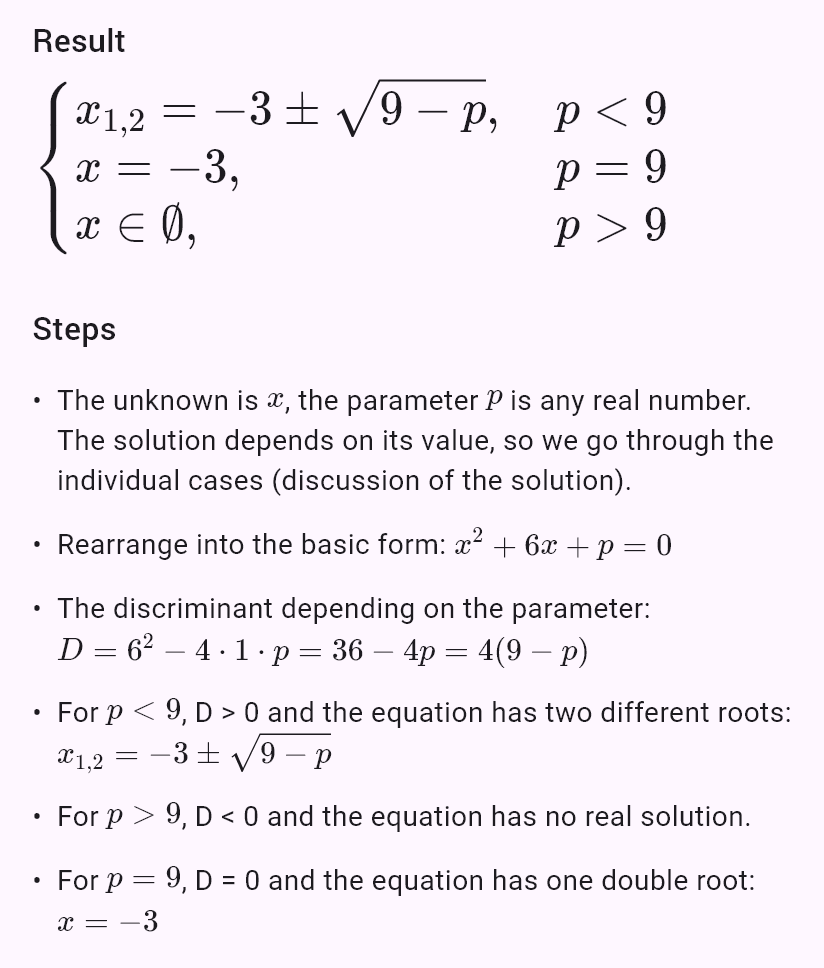
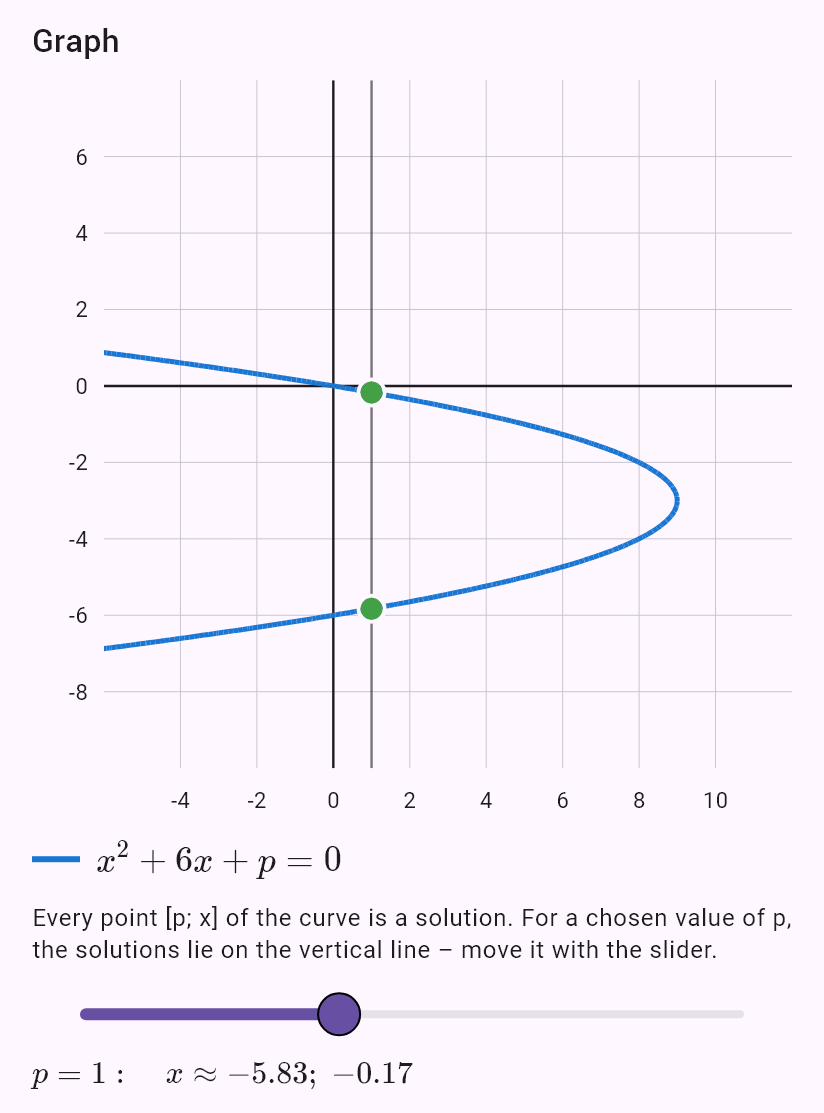
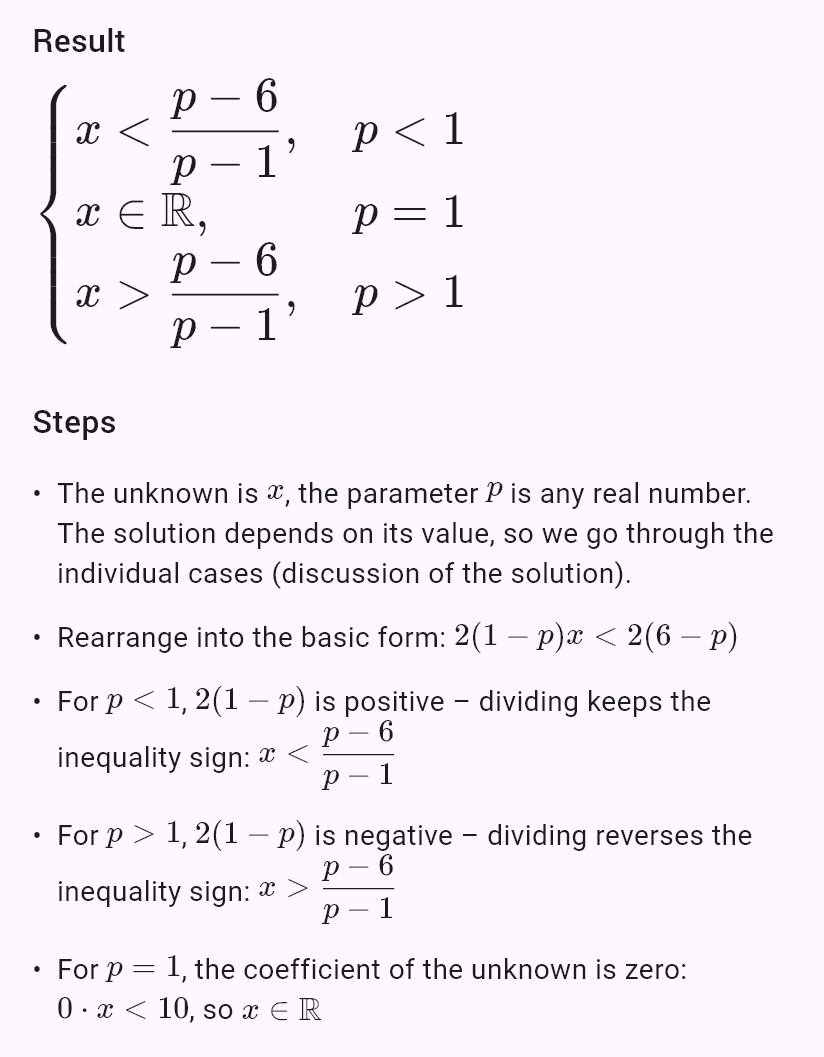
2x + 2p - 5 < 2px + 7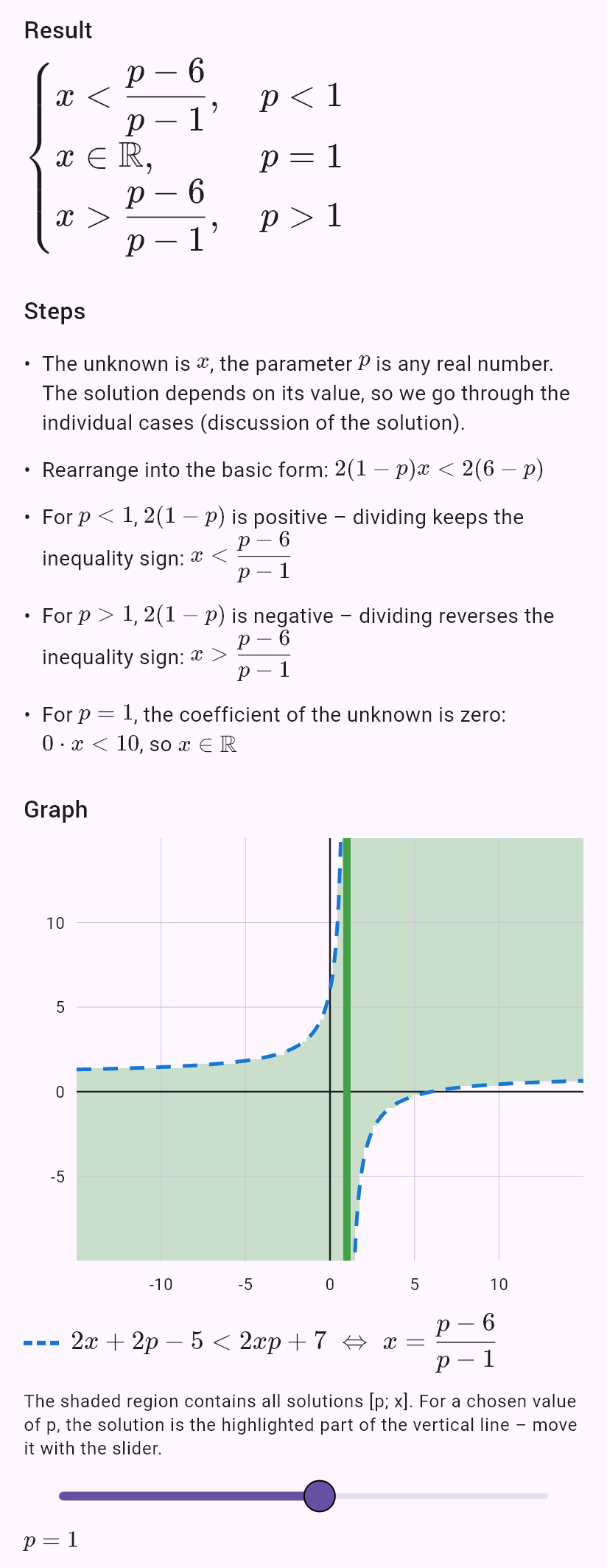
x^2 - 2px + p + 2 = 0, x > 1
ax + y = 1
x + ay = 1
(x - p)/(x - 1) > 0
Known limitations
- The full discussion by intervals with one parameter only, with more parameters the general cases.
- Questions about the roots only for linear and quadratic equations; systems with a parameter only two linear equations; a parameter in a root or a logarithm not yet.